
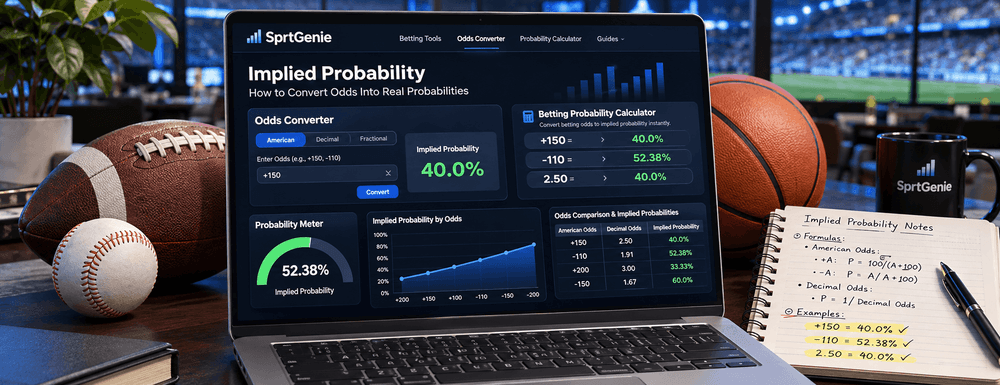
Implied Probability in Sports Betting: How to Convert Odds Into Real Probabilities
Learn to convert American, decimal, and fractional odds into implied probability, understand sportsbook margin, and use a betting probability calculator.
Implied Probability in Sports Betting: How to Convert Odds Into Real Probabilities
The odds on a sportsbook screen describe a price, not a guarantee. A +150 price and a -150 price imply different break-even thresholds, even when both relate to the same contest. Understanding implied probability sports betting is useful because it makes American, decimal, and fractional prices comparable on a common scale. This guide shows how to convert betting odds to probability, why two sides of a market often add up to more than 100%, and how to interpret the result correctly. A betting probability calculator can save arithmetic, but it cannot establish the true chance of an outcome. We will separate the math of prices from forecasts of sporting events.
What Implied Probability Really Means
Betting Prices and Break-Even Rates
Implied probability converts a betting price into the win rate needed to break even at that price over repeated comparable bets, ignoring other costs. At +100, the threshold is 50%; at +150, it is 40%; at -150, it is 60%. These percentages are properties of prices. An event's real chance remains uncertain and may differ from what the market implies.
American, Decimal, and Fractional Formats
American, decimal and fractional odds display the same economic relationship in different notation. +150 corresponds to decimal 2.50 and fractional 3/2; each means a $100 stake would yield $150 net profit if successful. Conversion changes the presentation, not the underlying payout. Decimal odds include returned stake, a frequent source of confusion.
How the Sportsbook Margin Changes the Picture
Bookmakers generally build a margin into prices. In a simple two-outcome market, summing raw implied probabilities can exceed 100%; the excess is called overround. That does not mean the mutually exclusive outcomes collectively have more than a 100% chance. It means quoted prices contain a margin, potentially distributed unevenly across selections.
How to Convert Betting Odds to Probability
Positive American Odds Formula
For positive American odds A, implied probability as a decimal is 100 / (A + 100). At +150 the computation is 100 / 250 = 0.40, or 40%. At +200 it is one-third, or 33.33%. Larger positive odds imply a lower break-even percentage and a larger potential net return for the same stake.
Negative American Odds Formula
For negative American odds -B, with B positive, implied probability is B / (B + 100). At -150 that is 150 / 250 = 60%. At -110 it is 110 / 210 ≈ 52.38%. The minus sign marks the price convention; it does not mean the probability is negative.
Decimal and Fractional Odds
For decimal odds D, implied probability is 1/D. Decimal 1.80 corresponds to 55.56%, while 2.50 corresponds to 40%. For fractional odds a/b, use b / (a + b): 5/2 implies 2/7 ≈ 28.57%. For each format, multiply the decimal probability by 100 to display a percentage.
How to Use a Betting Probability Calculator
A betting probability calculator should accept an odds format and return a price-implied percentage. Verify signs and decimal placement, and do not rely on rounded converted values when comparing tight differences. Confirm that the quote is current and belongs to the exact market you intend to analyze. The calculator performs conversion; it does not predict future game results.
Worked Example and Reference Tables
| Odds format | Example | Implied probability |
|---|---|---|
| American +150 | +150 | 40.00% |
| American -150 | -150 | 60.00% |
| Decimal | 2.50 | 40.00% |
| Fractional | 3/2 | 40.00% |
| American -110 | -110 | 52.38% |
| Two-sided market | Quoted price | Raw implied chance |
|---|---|---|
| Side A | -110 | 52.38% |
| Side B | -110 | 52.38% |
| Total | — | 104.76% |
| Proportional no-vig each | — | 50.00% |
No-Vig Probability and Fair Market Estimates
The -110/-110 Example
Consider two sides each offered at -110. Each price implies about 52.38%, so their raw total is approximately 104.76%. The excess 4.76 percentage points represents the overround under this simplified reading. This example is hypothetical, and not every sportsbook market has equal pricing or a symmetric margin.
Proportional Margin Removal
One simple no-vig method divides each raw implied probability by the sum across all mutually exclusive outcomes. With equal -110 prices, each normalized probability becomes 52.38 / 104.76 = 50%. Different margin-removal methods can produce different results when the two prices are uneven; normalization is an approximation, not a discovery of the true probabilities.
Why No-Vig Is Not a Certain Forecast
A no-vig probability remains a price-based estimate. Markets react to information, liquidity, limits and trading behavior, and may be wrong or inefficient. Removing a mathematical margin does not eliminate model uncertainty, information gaps, or the possibility of surprising sporting results.
Applying Implied Probability to Research
Compare the Same Market Across Sportsbooks
Suppose equivalent selections are offered at -110, -105 and +100. Their implied break-even percentages are 52.38%, 51.22% and 50% respectively. A researcher comparing the same outcome would prefer a more favorable price, all else equal. Confirm that thresholds, player, period and settlement rules match before declaring two quotes equivalent.
Contrast Market Prices With AI Estimates
A model's estimated 54% win probability can be compared with a sportsbook's 50% implied threshold at +100. The difference is an estimated probability edge, not a verified one. SprtGenie provides analytical context and market comparisons; checking its public results can help assess whether its past estimates were well calibrated. Do not mistake an attractive numerical gap for a guarantee.
Common Conversion Errors
Frequent mistakes include treating 60% implied probability as certainty, converting -150 as though it were +150, adding unrelated market outcomes together, and computing probability from display-rounded decimal odds. The safest habit is to preserve original quoted odds and calculation timestamps and to show the formula used.
Keep the original odds and timestamps with each calculation. The distinction between a price-derived percentage and a real-world forecast remains central to responsible odds analysis.
Practical Case Study
Suppose a reader sees a fictional moneyline of +175. The break-even calculation is 100/(175+100)=36.36%. At decimal odds 2.75, the same result is 1/2.75=36.36%. If the reader sees fractional 7/4, the probability is 4/(7+4)=36.36%. The formats convey one price, even though their display looks different. A spreadsheet or betting probability calculator can verify the arithmetic rapidly, but the underlying assumptions do not change.
Now consider a two-sided market with prices -120 and +100. The implied probabilities are 54.55% and 50.00%, totaling 104.55%. Proportional normalization yields approximately 52.17% and 47.83%. These numbers remove the overround under one method. They should not be called 'real probabilities' without qualification: bookmaker pricing might include uneven margins, and the market may not reflect all information accurately. This is why a dedicated implied-probability guide should focus on price mathematics instead of claiming to predict match outcomes.
FAQ:
1. What is implied probability sports betting?
Implied probability sports betting is the percentage encoded by a market price: the break-even win rate at those odds, under a simplified repeated-bet calculation. It is not necessarily the actual probability of the event, because the offered price may include margin and trading adjustments.
2. How do you convert betting odds to probability?
Use the formula matching the format: positive American 100/(A+100), negative American |A|/(|A|+100), decimal 1/D, or fractional b/(a+b). Multiply by 100 for a percentage. Confirm the sign and avoid calculating from unnecessarily rounded converted odds.
3. What probability does +150 imply?
At +150, the formula is 100/(150+100)=0.40. The implied probability is 40%. A winning $100 stake would return $150 in net profit; these figures come from the quoted price and do not predict whether the selection will win.
4. What probability does -110 imply?
At -110, the implied probability is 110/(110+100), or approximately 52.38%. This is the win rate needed to break even at that price, ignoring other expenses. It should not be interpreted as an independent expert forecast.
5. How do decimal odds convert into percentages?
Divide one by the decimal odds and multiply by 100. A decimal price of 2.50 implies 40%, while 1.80 implies approximately 55.56%. The result is a price-derived threshold rather than evidence of the true outcome probability.
6. How do fractional odds work?
For fractional a/b odds, calculate b/(a+b). For example, 3/2 implies 2/(3+2)=40%. Fractional 3/2 is the same underlying price as American +150 and decimal 2.50, assuming equivalent settlement conditions.
7. Can a betting probability calculator predict winners?
No. A betting probability calculator translates quoted prices into implied percentages; it does not know the actual chance of winning. Prediction requires separate modeling, current data and validation. A calculator can still be useful for comparing equivalent sportsbook offers consistently.
8. What is the sportsbook overround?
Overround is the amount by which summed raw implied probabilities across mutually exclusive market outcomes exceed 100%. Two -110 sides imply about 104.76% combined, illustrating a sportsbook margin. The excess is not a real extra chance of an event occurring.
9. What is a no-vig probability?
A no-vig estimate adjusts the listed prices to remove an assumed allocation of sportsbook margin. Simple proportional normalization divides each implied probability by their total. It is a useful price-based estimate, but it is not a verified true probability.
10. Is implied probability the true win probability?
Not necessarily. Implied probability is derived from bookmaker odds and may reflect vig, demand, information and market constraints. The actual chance is unknown before the event. Models offer additional estimates but must themselves be tested for calibration and error.
SprtGenie provides research and analytics, not a sportsbook or a guarantee of outcomes. Sports betting involves financial risk. 18+; follow applicable laws and responsible-gambling safeguards.