
How to Use AI for NFL Betting Predictions, Player Props, Spreads, and Totals
Explore how AI NFL predictions evaluate player props, spreads, totals, injuries, and odds. Learn to interpret probabilities and NFL market risks.
How to Use AI for NFL Betting Predictions, Player Props, Spreads, and Totals
NFL markets often appear straightforward: choose a winner, evaluate a point spread, or project a player's statistics. Yet each question draws on different data and requires a different probability estimate. Team strength, quarterback health, pass protection, pace, weather, and changing prices all interact. AI NFL predictions can organize this evidence, but they cannot turn an uncertain game into a certain result. This guide explains how NFL player prop predictions and NFL spread predictions differ from moneyline and total projections, how to translate prices into break-even thresholds, and how to judge model output without confusing a plausible forecast with an attractive market price. The objective is disciplined sports research—not a promise of winning picks.
How AI NFL Prediction Models Work
Key Inputs for AI NFL Predictions
An AI forecast begins with a carefully defined target. For a moneyline, it might estimate a team's chance of winning; for a spread, it predicts the distribution of scoring margin; for a passing-yard prop, it models an individual statistic. Useful inputs include opponent-adjusted efficiency, quarterback pressure, injuries, rest, travel, and weather. Raw season averages can deceive when the opponents, roster, or game situations differ. A capable system therefore weights context and recognizes that personnel and coaching decisions may shift during the week.
How Machine Learning Estimates Outcomes
Historical examples train a model to associate pregame features with eventual results. Proper time ordering is essential: information recorded after kickoff cannot be treated as a pregame input. Models may simulate possessions or estimate outcome distributions, but accuracy must be measured on future games held out from training. Retraining can adapt to roster changes; too much tuning to a small past sample can instead create overfitting.
Win Probability, Confidence, and Risk
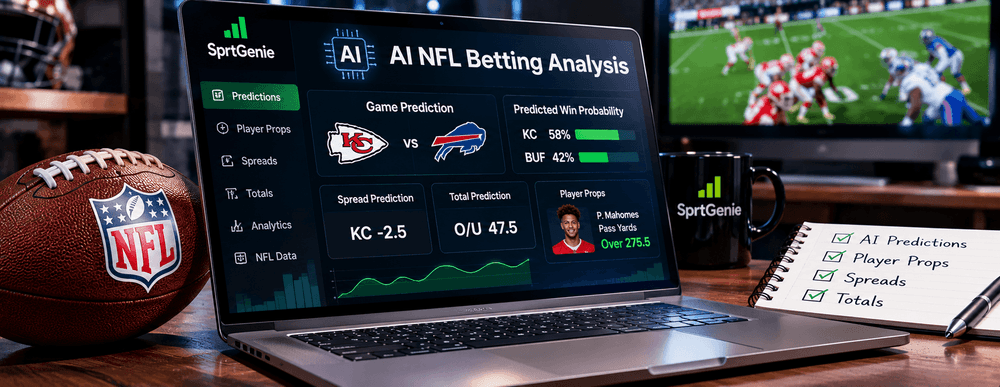
A 58% win probability expresses an estimate about an outcome, not a certificate of certainty. A confidence score may reflect model agreement, feature quality, or another platform-specific calculation. A risk rating may flag volatility or missing data. These metrics should be read separately. If a dashboard says “High,” ask what that label means, how its thresholds are chosen, and whether past forecasts in the same category behaved as advertised.
Analyzing NFL Markets With AI
Moneylines and Straight-Up Winners
Moneyline models evaluate straight-up winners, but the favorite's chance of winning is only part of the decision. A team estimated at 70% may still be overpriced if the sportsbook's break-even requirement is higher. The model should be calibrated to comparable games and checked against current injuries. The listed American odds then determine the price paid for that probability.
NFL Spread Predictions
NFL spread predictions require a distribution of score differences rather than only the average final margin. A team projected to win by four does not automatically have an attractive chance of covering -3.5 at any price. Key NFL margins such as 3 and 7 make movement across half-points especially consequential. Always compare both the threshold and price; -3 at -120 is not the same contract as -3.5 at -110.
NFL Player Prop Predictions
NFL player prop predictions depend on opportunities as much as talent. Quarterback yards respond to expected attempts, protection and coverage; receiving yards respond to routes, target share and defensive matchups; rushing volume can change with game script. A projection of 69 receiving yards is not itself the probability of exceeding 65.5. That probability requires an uncertainty distribution, including low- and high-volume scenarios.
Game Totals and Over/Under Analysis
Totals models consider possessions, play pace, scoring efficiency, red-zone performance and weather. Wind can matter more for some passing environments than light rain alone. Injuries can change both the offensive ceiling and the opponent's opportunities. The estimated chance of an over or under must match the exact posted threshold, which may move throughout the week.
Worked Example and Reference Tables
| NFL market | Primary modeling target | Typical context |
|---|---|---|
| Moneyline | Probability team wins | Quarterback, defense, injuries |
| Spread | Margin distribution / cover chance | Key numbers and quoted price |
| Player prop | Player statistic distribution | Snaps, targets, usage |
| Game total | Total points distribution | Pace, weather, scoring efficiency |
| Illustrative quote | Implied probability | Hypothetical model estimate |
|---|---|---|
| Spread -110 | 52.38% | 57% |
| Moneyline +150 | 40.00% | 45% |
| Player prop -105 | 51.22% | 55% |
How to Interpret NFL Odds and Model Value
Convert Odds Into Implied Probability
American odds of -110 imply a break-even probability of 110 / 210, or 52.38%, before considering the true unknown chance. Suppose a model estimates 57% to cover the same -110 spread: its estimated edge in probability terms is 4.62 percentage points. That comparison is meaningful only if the model and sportsbook refer to identical teams, thresholds, settlement terms and timestamps.
Check Model Edge and Expected Value
For a $100 stake at -105, a winning bet returns about $95.24 in net profit and a losing bet costs $100. With a hypothetical 57% chance, estimated EV is 0.57 × $95.24 − 0.43 × $100 ≈ $11.29 per $100 staked. It is a model-based estimate, not an expected cash payment on the next game. If the 57% forecast is too optimistic, the apparent advantage can disappear.
Avoid Common Model-Use Errors
An injury update released after a forecast can make its inputs stale. Other common errors include using the wrong market side, failing to distinguish spread prices, treating related player props as independent, or selecting only successful historical examples. A credible research record retains the losing forecasts and includes every forecast's original timestamp and available price.
Using SprtGenie for NFL Research
Step-by-Step Research Workflow
A practical SprtGenie workflow starts with one NFL game and one specific market. Read the available prediction, note the model probability and risk context, verify lineup news, and compare equivalent sportsbook prices. Record the quote and its time before interpreting an edge. Later, revisit the result and compare the closing market rather than remembering only the best early number.
Evaluate Prediction Performance
Track performance across many dated selections. Win rate alone is not enough: ROI depends on odds, closing-line value compares entry and closing prices, and calibration checks whether groups of forecasts occur at approximately their predicted frequencies. A 60% model needs representative cases to judge its forecasts; a few screenshots cannot establish its reliability.
Responsible Interpretation
SprtGenie is a research and analytics platform rather than a sportsbook. Its tools can help organize predictions and prices, but every forecast has uncertainty and pricing may change quickly. Only adults 18+ in permitted jurisdictions should consider gambling; set limits and never treat model confidence as permission to chase a loss.
The best use of AI NFL predictions is to document assumptions, compare like-for-like markets, and evaluate forecasts over time. Football uncertainty remains even when the analysis is detailed.
Practical Case Study
Consider a fictional Sunday matchup between Harbor City and Mountain State. A research model assigns Harbor City a 59% chance of winning, but the available moneyline is -160, implying 61.54%. Although the model calls Harbor City the more likely winner, its estimate is below the price's break-even threshold. For a spread at -2.5 (-110), the same model might estimate a 55% cover probability; that is a different event from winning outright. A quarterback prop at 249.5 passing yards requires a separate distribution based on expected dropbacks and defensive pressure. These outputs should not be treated as interchangeable votes for one side.
Now imagine a late weather forecast predicts strong winds. The model's passing-yard projection may decline, changing the probability of the under, while the team moneyline effect may be much smaller. A dashboard that updates one market but not another can become internally inconsistent. Record each forecast's timestamp, affected inputs, and price. A rigorous NFL article should teach how to compare distinct markets without assuming that one favorable statistic validates every possible selection.
FAQ:
1. What are ai NFL predictions?
AI NFL predictions are statistical estimates built from football data such as team efficiency, personnel, matchups, and market context. They can express win or cover probabilities, but they do not know the final result in advance. The quality of estimates depends on data freshness and calibration.
2. How does AI estimate NFL game winners?
Models combine quarterback play, defense, injuries, rest, weather and other pregame signals to estimate outcome distributions. Some simulate possessions while others learn statistical relationships. A predicted favorite is simply the team with the higher estimated win probability, not a guaranteed winner.
3. Can NFL spread predictions account for key numbers?
Yes, a spread model can estimate how often different victory margins occur and account for important numbers such as three or seven. The value of -3 and -3.5 can differ meaningfully. Always compare the exact threshold and price of the quote.
4. How do NFL player prop predictions work?
They project player workload and statistical distributions using snaps, target share, expected attempts, opponent tendencies and game script. An expected yardage figure alone is not a cover probability. NFL player prop predictions should specify the exact sportsbook threshold.
5. Which inputs matter most for quarterback props?
Expected passing attempts, protection, defensive coverage, weather and the availability of pass catchers are important. A late offensive-line injury or quarterback change can undermine a forecast. Models should timestamp information and revise estimates when reliable inputs change.
6. Can AI estimate NFL totals?
Models estimate scoring distributions from possessions, pace, team efficiency, red-zone outcomes and game conditions. The probability of an over depends on the offered total and its price. A projected average score is not sufficient to establish the chance of a particular over.
7. Why can a high-confidence NFL prediction lose?
High confidence does not mean certainty. Unexpected turnovers, injuries, penalties and normal sports variability can produce losses even when a model is appropriately calibrated. Confidence may also describe data quality rather than an 80% or 90% win probability.
8. How do injuries change model output?
An injury can change team efficiency, expected plays and individual opportunities. Updated projections should account for replacement talent and strategic changes rather than apply the same adjustment to every absence. Always inspect when both the injury report and model forecast were updated.
9. How do you compare model probabilities with NFL odds?
Convert the available odds into a break-even percentage and compare that with a calibrated estimate for the identical market. For example, -110 implies 52.38%. An estimate above that figure is only a potential model-based edge, not proof of value.
10. Does SprtGenie guarantee accurate NFL picks?
No. SprtGenie provides sports research, probability estimates and related analytical tools, not guaranteed outcomes. Publicly graded results can help assess performance over time, but past accuracy does not establish certainty or remove the risk of financial loss.
SprtGenie provides research and analytics, not a sportsbook or a guarantee of outcomes. Sports betting involves financial risk. 18+; follow applicable laws and responsible-gambling safeguards.