
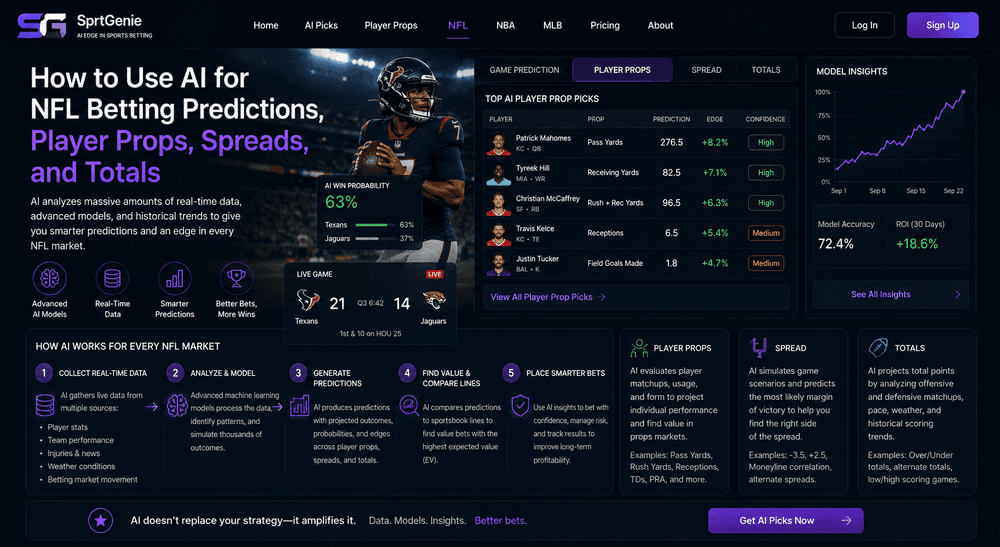
Artificial intelligence can process these variables at scale and convert them into probability-based insights. An AI NFL betting platform may estimate which team is more likely to win, whether a team can cover the point spread, how many points the game may produce, or whether a player will exceed a statistical prop line.
AI's advantage is not that it can guarantee the result. NFL games remain uncertain and can change because of turnovers, penalties, injuries, weather, and coaching decisions. AI is valuable because it can organize data, apply a consistent analytical process, update projections, and compare model probabilities with sportsbook prices.
To use AI effectively, bettors must understand what the model is predicting, which information supports the estimate, and whether the available odds offer sufficient value.
What Is AI NFL Betting Analysis?
AI NFL betting analysis uses statistical models, machine learning, simulations, or other automated methods to evaluate football games and betting markets.
The process may include:
- Collecting historical and current NFL data
- Estimating team and player performance
- Simulating possible game outcomes
- Calculating market probabilities
- Comparing probabilities with sportsbook odds
- Assigning confidence and risk ratings
- Updating the prediction after new information
AI can support analysis for:
- Moneylines
- Point spreads
- Game totals
- Team totals
- Quarter and half markets
- Player props
- Parlays
- Live NFL betting
A complete prediction should provide more than a suggested pick. Users should be able to review the estimated probability, current line, available odds, model edge, confidence, risk, supporting data, and update time.
AI NFL Picks vs. Traditional Handicapping
Traditional NFL handicappers may study statistics, game film, coaching tendencies, injuries, and sportsbook line movement. Experienced analysts can interpret tactical and contextual information that may be difficult to convert into structured data.
AI offers different advantages. It can process large datasets, compare many markets, run simulations, and apply the same analytical rules consistently.
| Area | AI analysis | Human handicapping |
|---|---|---|
| Data volume | Processes large datasets | Limited by research time |
| Speed | Updates rapidly | Requires manual review |
| Consistency | Applies defined model rules | Can vary by analyst |
| Emotional bias | Less affected by loyalty or narratives | May be influenced by opinion |
| Film and tactical context | Depends on available data | Can interpret game film directly |
| Multi-market coverage | Can analyze many games and props | Usually more specialized |
The approaches can be combined. AI can identify potential opportunities, while human review can determine whether the model reflects the latest tactical and personnel context.
What Data Does AI Use for NFL Predictions?
NFL models require team, player, matchup, situational, weather, and market data.
Team Performance
Relevant team metrics may include:
- Points scored and allowed
- Offensive and defensive efficiency
- Success rate
- Red-zone performance
- Third-down performance
- Turnover rate
- Explosive plays
- Home and away performance
- Strength of schedule
Adjust raw averages for opponent quality. Scoring 30 points against a weak defense does not provide the same information as producing 30 points against an elite defense.
Quarterback Performance
Quarterback play has a major effect on NFL projections.
AI may evaluate:
- Completion rate
- Passing yards
- Accuracy
- Touchdown and interception rates
- Sack rate
- Performance under pressure
- Rushing contribution
- Expected points added
- Receiver availability
A quarterback change can affect the moneyline, spread, total, and several player props simultaneously.
Offensive Line Performance
The offensive line influences both passing and rushing outcomes.
Relevant variables include:
- Pressure allowed
- Sack rate
- Pass protection
- Run blocking
- Starting lineup
- Injuries
- Continuity
A model that evaluates the quarterback without accounting for offensive line injuries may overestimate the offense.
Defensive Matchups
NFL defenses can perform differently against passing and rushing attacks.
AI may analyze:
- Pressure rate
- Coverage scheme
- Run defense
- Pass defense
- Explosive plays allowed
- Red-zone defense
- Performance against specific positions
- Injured defensive starters
These variables are especially important for player props.
Player Usage and Workload
Player production depends on opportunity.
Workload indicators include:
- Snaps
- Routes
- Targets
- Carries
- Receptions
- Red-zone opportunities
- Goal-line work
- Two-minute offense participation
A running back can have strong per-carry efficiency but remain unlikely to exceed a rushing prop if the team uses a committee.
Injuries and Inactive Players
The model should reflect:
- Starting quarterback status
- Offensive line availability
- Running backs and receivers
- Tight ends
- Defensive starters
- Kicker availability
- Expected limitations
The final inactive list can materially change game and player probabilities.
Schedule and Situational Factors
AI may account for:
- Rest days
- Short weeks
- Travel
- Time-zone changes
- Divisional games
- Previous overtime
- Consecutive road games
- Playoff implications
Treat these factors as part of the complete model rather than isolated betting narratives.
Weather and Venue
Weather can influence NFL passing, rushing, scoring, and kicking.
Important variables include:
- Wind
- Rain
- Snow
- Temperature
- Field conditions
- Indoor or outdoor venue
- Playing surface
Wind can be more relevant than a general cold-weather forecast. Models should evaluate how conditions affect the specific offense, players, and markets.
Sportsbook Market Data
NFL models may monitor:
- Opening line
- Current line
- Moneyline
- Point spread
- Game total
- Player props
- Line movement
- Prices across sportsbooks
Market data determines whether a prediction offers potential value at the current price.
How AI Turns NFL Data Into Predictions
Step 1: Collect and Validate Information
The platform combines statistics, injuries, weather, schedules, lineups, and sportsbook odds.
It must remove outdated records, correct inconsistencies, and confirm that every market belongs to the correct game.
Step 2: Create Predictive Features
Raw data can be transformed into variables such as:
- Opponent-adjusted efficiency
- Expected pace
- Quarterback matchup
- Offensive line advantage
- Defensive pressure mismatch
- Rest adjustment
- Weather-adjusted passing efficiency
Step 3: Simulate the Game
The model can simulate the matchup many times.
Each simulation may estimate:
- Number of possessions
- Scoring on each possession
- Player workload
- Final score
- Margin of victory
- Total points
The distribution of simulated results can be used to calculate market probabilities.
Step 4: Calculate Betting Probabilities
The system may estimate:
- Moneyline win probability
- Probability of covering a spread
- Probability of going over or under
- Probability of a player exceeding a prop
- Joint probability of parlay legs
Step 5: Compare the Model With the Market
Convert sportsbook odds to implied probability and compare them with the AI estimate.
The model may identify potential value when its probability is higher than the market’s implied or no-vig probability.
Step 6: Assign Confidence and Risk
Confidence may reflect data quality, lineup certainty, model agreement, and stability.
Risk may increase because of:
- Questionable quarterback
- Uncertain player workload
- Severe weather
- Rapid market movement
- Limited sample
- Volatile player prop
Step 7: Update the Analysis
Predictions can be recalculated after:
- Practice reports
- Injury updates
- Inactive lists
- Weather changes
- Line movement
- Live game events
How to Use AI for NFL Moneyline Predictions
An NFL moneyline bet focuses only on which team wins.
Favorites use negative American odds, while underdogs normally use positive odds.
A model should estimate each team’s win probability and compare that probability with the sportsbook price.
Moneyline Example
Suppose an AI model estimates:
- Team A win probability: 57%
- Available odds: -105
- Implied probability: approximately 51.22%
At -105, a $100 risk produces approximately $95.24 in profit.
Expected value is:
EV = (0.57 × $95.24) − (0.43 × $100)
EV = $54.29 − $43
EV = +$11.29
The theoretical EV is approximately +11.29% of the amount risked.
This calculation depends on the accuracy of the 57% estimate. It does not guarantee that Team A will win.
Common NFL Moneyline Mistakes
- Betting only on the team considered most likely to win.
- Ignoring the sportsbook price
- Overpaying for popular favorites
- Using outdated quarterback information
- Failing to compare sportsbooks
- Evaluating one result instead of long-term performance
A favorite can be likely to win but still be overpriced.
How to Use AI for NFL Spread Predictions
The point spread creates a scoring advantage or disadvantage for betting purposes.
If a favorite is -3.5, it generally must win by at least four points to cover. An underdog at +3.5 can lose by up to three points and still cover.
AI spread models estimate the distribution of possible scoring margins rather than only predicting the winner.
Relevant variables include:
- Offensive and defensive efficiency
- Quarterback matchup
- Turnovers
- Expected possessions
- Red-zone performance
- Weather
- Home-field advantage
- Game script
Probability of Covering
Suppose the model projects a favorite to win by an average of 4.2 points, while the sportsbook spread is -3.
The projection alone is not enough. The model must estimate how frequently the team covers -3 across the simulated distribution.
It may produce:
- Probability of covering -3: 54%
- Probability of pushing: 3%
- Probability of failing to cover: 43%
The available price and key-number value must also be reviewed.
NFL Key Numbers
Margins of 3 and 7 are particularly important because of common NFL scoring patterns.
The difference between:
- -3 and -3.5
- +2.5 and +3
- +3 and +3.5
- -7 and -7.5
can be more meaningful than an ordinary half-point elsewhere.
A bettor should not accept a slightly better price without considering whether the alternative spread crosses a key number.
Common Spread-Betting Mistakes
- Confusing the projected winner with the team most likely to cover
- Ignoring key numbers
- Comparing different spreads as identical markets
- Focusing only on recent scores
- Chasing the line after the model edge disappears
- Ignoring the price attached to the spread
How to Use AI for NFL Totals Predictions
NFL totals ask whether the combined score will finish over or under a sportsbook threshold.
An AI totals model may estimate:
- Expected number of possessions
- Offensive pace
- Passing and rushing efficiency
- Explosive-play probability
- Red-zone conversion
- Turnover probability
- Field-goal opportunities
- Defensive matchup
- Weather
Weather and NFL Totals
Weather analysis should be specific.
Strong wind can reduce deep passing efficiency and field-goal range. Heavy rain may affect ball security and playing conditions. Snow can influence footing, but its effect depends on severity, temperature, and field maintenance.
The model should avoid assuming every cold-weather game must go under.
Injuries and Totals
Totals can change because of:
- Quarterback availability
- Offensive line injuries
- Missing receivers
- Running back workload
- Defensive absences
- Kicker status
An injured defensive starter can increase projected scoring, while an unavailable quarterback may reduce it.
NFL Total Example
Suppose:
- AI projected total: 46.8
- Sportsbook total: 44.5
- Estimated over probability: 56%
- Available odds: -110
- Implied probability: approximately 52.38%
At a $100 risk, -110 produces approximately $90.91 in profit.
EV = (0.56 × $90.91) − (0.44 × $100)
EV = $50.91 − $44
EV = +$6.91
The estimated EV is approximately +6.91%.
Confirm weather, injuries, and line movement before evaluating the selection.
How to Use AI for NFL Player Props
NFL player prop models require detailed workload and matchup projections.
Quarterback Props
Common quarterback markets include:
- Passing yards
- Passing touchdowns
- Completions
- Attempts
- Interceptions
- Rushing yards
- Longest completion
AI may evaluate:
- Expected attempts
- Defensive pressure
- Coverage
- Offensive line
- Receiver availability
- Weather
- Expected game script
A quarterback expected to play from behind may receive more passing volume. A heavily favored team may reduce passing attempts while protecting a lead.
Running Back Props
Common markets include:
- Rushing yards
- Carries
- Receptions
- Receiving yards
- Anytime touchdown
- Longest rush
Relevant variables include:
- Snap share
- Expected carries
- Goal-line role
- Offensive line
- Opponent run defense
- Backup usage
- Point spread
- Game script
A running back’s rushing over may conflict with an analysis expecting the team to trail and pass frequently.
Wide Receiver and Tight End Props
Common markets include:
- Receptions
- Receiving yards
- Targets
- Longest reception
- Anytime touchdown
AI may analyze:
- Route participation
- Target share
- Air yards
- Opponent coverage
- Quarterback efficiency
- Injuries to teammates
- Expected pass attempts
Player Prop Example
Suppose the model produces:
- Quarterback passing projection: 286 yards
- Sportsbook line: 274.5
- Estimated over probability: 57%
- Available odds: -105
- Implied probability: approximately 51.22%
The simplified model edge is:
57% − 51.22% = 5.78 percentage points
The user should still review weather, offensive line injuries, receiver availability, and whether the price remains current.
Understanding Probability, Confidence, and Risk
These metrics answer different questions.
Win Probability
How likely is the selected outcome to occur?
A 70% probability still includes a 30% chance of losing.
Confidence Score
How strongly does the available data support the probability estimate?
Confidence may decrease when the quarterback is questionable, or the weather forecast is unstable.
Risk Rating
How uncertain or volatile is the selection?
A touchdown scorer prop may have strong supporting data but still carry high risk because touchdowns are relatively infrequent.
Reading the Metrics Together
A model may display:
- Win probability: 58%
- Confidence: high
- Risk: medium
- Sportsbook implied probability: 54%
This suggests a relatively stable model estimate and a four-point difference from the market.
Another prediction may show:
- Win probability: 63%
- Confidence: low
- Risk: high
- Sportsbook implied probability: 50%
The apparent edge is larger, but the probability depends on uncertain information. The second selection may require more caution despite its higher estimated probability.
Calculating Implied Probability and Model Edge
For positive American odds:
Implied probability = 100 ÷ (positive odds + 100)
For negative American odds:
Implied probability = Absolute odds ÷ (Absolute odds + 100)
Model edge is:
Model edge = AI probability − Market probability
A positive model edge indicates that the AI estimates the outcome as more likely than the market does.
The difference can reflect value, model error, stale odds, or missing information. It should not be followed automatically.
Why Real-Time NFL Odds Matter
NFL prices can change significantly during the week.
Movement may follow:
- Quarterback injury news
- Practice participation
- Offensive line changes
- Weather forecasts
- Final inactive lists
- Betting activity
A prediction can remain unchanged while the price becomes unfavorable.
Suppose an AI model estimates an underdog at 45%.
At +140, implied probability is 41.67%.
At +115, implied probability is 46.51%.
The selection may offer a model edge at +140 but not at +115.
Users should confirm the current odds rather than relying on the price shown when the prediction was first generated.
NFL Line Shopping
Line shopping means comparing prices across multiple sportsbooks.
Moneylines
For the same underdog, +145 is more favorable than +125. For the same favorite, -115 is more favorable than -135.
Spreads
Compare both the spread and price:
- +3 at -105
- +3.5 at -120
The first has a better price, but the second includes a valuable half-point. The strongest choice depends on the model’s probability for each line.
Totals
Compare:
- Over 44.5 at -110
- Over 45 at -105
- Over 45.5 at +100
These are not identical markets. Evaluate the threshold and price together.
Player Props
Sportsbooks may post different yardage, reception, or scoring thresholds. Participation and settlement rules may also differ.
Consistently obtaining better odds can lower the break-even requirement and improve long-term expected value without changing the underlying pick.
How AI Analyzes NFL Game Script
Game script describes how a game may develop and how that development affects team and player behavior.
Favorite Playing From Ahead
A team protecting a lead may:
- Run more frequently
- Reduce passing attempts
- Use more clock
- Create defensive pressure opportunities.
- Limit the opponent’s rushing volume.
Underdog Playing From Behind
A trailing team may:
- Increase pass attempts
- Target receivers more frequently
- Reduce rushing volume
- Take more aggressive fourth-down decisions.
- Increase turnover risk
Close Game
A competitive game may produce:
- More balanced play calling
- Stable player usage
- Greater late-game passing
- Field-goal and overtime possibilities
Game-script assumptions should be consistent across moneyline, total, and player prop predictions.
AI NFL Predictions Throughout the Week
Early Week
Early predictions use opening lines and preliminary injury information.
Potential advantages include less market adjustment. Risks include greater uncertainty around lineups and weather.
Midweek
Practice reports, coaching comments, and updated weather provide additional information. Sportsbook lines may begin responding more clearly.
Game Day
Final inactive lists, confirmed weather, and current prices allow the model to produce a more complete projection.
The available odds may be less favorable if the market has already moved in the same direction.
Live NFL Betting
Live AI models can process:
- Score
- Time remaining
- Possession
- Field position
- Down and distance
- Timeouts
- Player performance
- Injuries
A pregame favorite that falls behind may still have a substantial win probability if much of the game remains. An injury to the quarterback can produce a more significant change than the score alone.
Live betting introduces additional risks:
- Broadcast delay
- Data latency
- Market suspension
- Requoted odds
- Rapid emotional decisions
Every live insight should display the current score, clock, market, odds, and update time.
AI NFL Parlays and Same-Game Parlays
AI can evaluate individual parlay legs and estimate their combined probability.
Common NFL legs include:
- Moneyline
- Spread
- Game total
- Quarterback props
- Running back props
- Receiver props
- Touchdown scorers
Correlation
Some selections are related.
Examples of possible positive correlation:
- Quarterback passing over and receiver yards over.
- Team leading and running back carries over.
- Game total over and touchdown scorer
Potentially conflicting selections may include:
- Several passing overs with a strong game-under assumption
- Running back carries over with the same team expected to trail heavily.
- Star player over with a blowout script that reduces playing time
AI can use historical relationships and simulations to estimate joint probability.
Adding more legs reduces the probability that every outcome succeeds and introduces additional model error.
Common AI NFL Betting Mistakes
Treating AI Picks as Guarantees
AI estimates probabilities. It cannot determine the final result.
Using Outdated Injury Information
Quarterback and offensive line changes can affect multiple markets.
Overreacting to Recent Games
One strong or weak performance may not represent the team’s current ability.
Ignoring Key Numbers
A half-point around 3 or 7 can be significant.
Accepting the First Price
Different sportsbooks may offer materially different lines and odds.
Confusing Probability With Value
The most likely winner may still be overpriced.
Adding Too Many Parlay Legs
Several good individual picks can create one low-probability combination.
Evaluating a Small Sample
A short winning streak does not establish model accuracy.
Increasing Stakes After Losses
Previous losses do not make the next prediction more likely to win.
How to Evaluate an AI NFL Betting App
A useful NFL platform should provide:
- NFL-specific team and player data
- Injury and inactive updates
- Weather
- Moneyline probabilities
- Spread probabilities
- Total probabilities
- Player prop projections
- Real-time sportsbook odds
- Confidence and risk
- Clear timestamps
- Explanations
Historical performance should include:
- Sample size
- Average odds
- Win rate
- Return on investment
- Probability calibration
- Closing line value
- Results by NFL market
Avoid platforms that advertise guaranteed wins or unverifiable accuracy percentages.
Step-by-Step AI NFL Betting Research Process
Step 1: Select the Game and Market
Choose a moneyline, spread, total, or player prop.
Step 2: Review the AI Prediction
Identify the selection, model probability, and supporting factors.
Step 3: Review Confidence and Risk
Understand data strength and uncertainty.
Step 4: Check Injuries
Confirm quarterbacks, offensive line, skill players, and defensive starters.
Step 5: Check Weather and Venue
Evaluate whether conditions affect passing, kicking, or total scoring.
Step 6: Review Game Script
Ensure the selection matches the model’s expected version of the game.
Step 7: Compare Sportsbooks
Review the exact line and price at several available operators.
Step 8: Calculate Implied Probability and EV
Compare the market price with the AI estimate.
Step 9: Confirm the Timestamp
Make sure the prediction and odds are current.
Step 10: Bet or Pass
Passing may be appropriate when the price moves or uncertainty is too high.
Step 11: Record the Selection
Track the sportsbook, line, odds, probability, closing price, and result.
How SprtGenie Supports AI NFL Analysis
SprtGenie combines AI-powered sports predictions with real-time odds, confidence information, risk ratings, and personalized insights through mobile and web applications.
The platform can support NFL research by helping users evaluate:
- Game-winner probabilities
- Point spreads
- Game totals
- Player props
- Live NFL markets
- Current sportsbook odds
- Confidence and risk
SprtGenie’s SnapTap feature lets users capture a photo or short video of a game. The platform can recognize the NFL matchup and provide relevant AI insights, suggested picks, odds, confidence, and risk.
This can reduce the time required to identify a live game and access associated analysis. Users should still verify the score, clock, market, and current price.
SprtGenie is a research and insights tool. It cannot guarantee the result of an NFL game, player prop, or parlay.
AI NFL Betting Checklist
Before evaluating an NFL prediction, ask:
- Is the starting quarterback confirmed?
- Are offensive line injuries included?
- Are important defensive absences reflected?
- Is the expected player workload realistic?
- Does the model account for the opponent matchup?
- Has the weather forecast been updated?
- What game script does the prediction assume?
- What is the model probability?
- How are confidence and risk defined?
- What probability is implied by the sportsbook odds?
- Is the model edge positive?
- Does the price offer potential expected value?
- Have several sportsbooks been compared?
- Does the spread cross a key number?
- Are the displayed odds still available?
- When was the prediction updated?
- Would passing be more appropriate?
Final Thoughts
AI can make NFL betting research faster, more consistent, and more probability-focused.
It can process team efficiency, quarterback performance, offensive line quality, defensive matchups, player workload, injuries, weather, and sportsbook odds. It can then generate separate probabilities for moneylines, point spreads, totals, player props, parlays, and live markets.
Each NFL market requires a different model. A team can be likely to win without being likely to cover. A high total projection may not offer value after the line moves. A strong player projection can fail if the expected game script changes.
Real-time sportsbook odds are essential because a bet's quality depends on price as well as probability. A prediction that appears valuable at one sportsbook may be unfavorable at another.
AI cannot eliminate turnovers, injuries, penalties, or random variation. It should support research rather than replace judgment.
Users should verify current information, compare sportsbook prices, understand confidence and risk, and remain willing to pass when the line no longer supports the prediction. All decisions should be made responsibly and in accordance with applicable age and jurisdiction requirements.
FAQ:
How does AI predict NFL games?
AI analyzes historical performance, team strength, quarterbacks, injuries, matchups, weather, schedules, and sportsbook markets. It may simulate the game to estimate a range of outcomes.
What data does AI use for NFL betting predictions?
Common inputs include offensive and defensive efficiency, quarterback performance, offensive line quality, player workload, injuries, weather, rest, travel, and current odds.
Can AI predict NFL moneylines?
AI can estimate each team’s probability of winning and compare that estimate with the probability implied by moneyline odds.
How does AI calculate NFL spread predictions?
The model estimates the distribution of scoring margins and calculates how frequently each team covers a specific spread.
Can AI predict NFL game totals?
AI can project total scoring using expected possessions, efficiency, weather, injuries, pace, and red-zone performance.
How does weather affect AI NFL predictions?
Wind, precipitation, temperature, and field conditions may affect passing, rushing, kicking, turnovers, and scoring. The impact depends on severity and matchup.
Can AI predict NFL player props?
AI can project quarterback, running back, receiver, tight end, and other player markets using expected workload, matchup, game script, and current line.
How does AI estimate quarterback and receiver props?
Quarterback models may evaluate expected attempts, pressure, weather, and receiver availability. Receiver models may use routes, targets, air yards, coverage, and expected pass volume.
What is an AI NFL confidence score?
It describes how strongly the available data supports the probability estimate. It may reflect model agreement, injury certainty, data quality, and prediction stability.
Can AI identify positive-EV NFL bets?
AI can compare its probability estimate with sportsbook odds to identify a potential model edge. Positive EV does not guarantee that the selection will win.
Why do AI NFL predictions change during the week?
Practice reports, injuries, inactive players, weather forecasts, and sportsbook line movement can alter the projection.
Can AI analyze live NFL betting markets?
AI can update probabilities using the score, clock, possession, field position, timeouts, player performance, injuries, and live odds.
Can AI build NFL same-game parlays?
AI can estimate individual leg probabilities and analyze correlation. Every additional leg lowers combined probability and adds uncertainty.
Are AI NFL betting predictions guaranteed to win?
No. AI predictions are probability estimates and cannot guarantee the outcome of an NFL game or betting market.