
How Real-Time AI Insights Are Changing Live Sports Betting Analysis
Explore how live betting predictions, in-game data, and real time betting insights help explain changing probabilities, odds, and market risks.
How Real-Time AI Insights Are Changing Live Sports Betting Analysis
A pregame probability is a forecast made before play begins. A live probability is a moving estimate that responds to score, time, possession, player availability, and the latest information. Live betting predictions make those changes visible, but the speed of the market creates a fundamental challenge: the data on a screen may already be stale when someone acts on it.
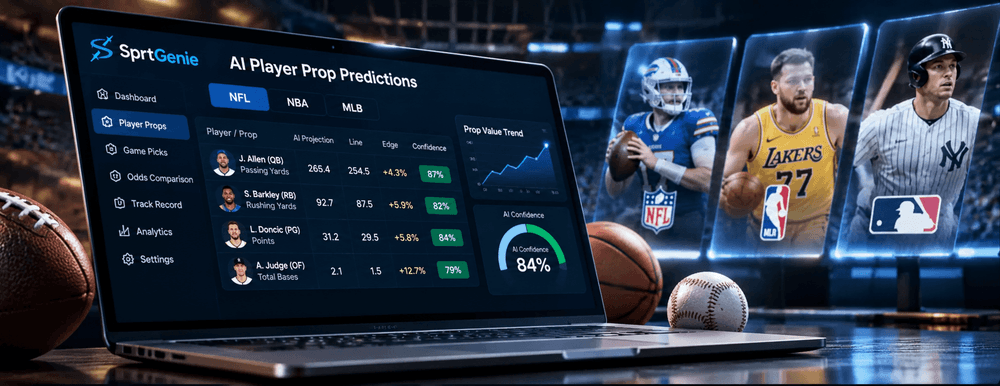
Real time betting insights can help readers understand why a market moves. An ai live betting app may bring game recognition, odds comparison, and analytics into one interface, but the strongest experience makes delays, data provenance, and uncertainty clear. The goal is informed interpretation, not the illusion that an algorithm can predict every next play.
How AI Models Update In-Game Probabilities
Starting with a pregame baseline
An in-game model typically starts with estimates derived from team strength, roster information, historical results, and available market prices. It then updates as the event unfolds. In football, current score, field position, timeouts, down and distance, and remaining possessions can matter. In basketball, pace, foul accumulation, and expected lineups shape the remaining scoring distribution.
Models are not omniscient. A live probability may react slowly to a player injury if the feed is delayed, and a statistical model may overreact to a short shooting streak. Good model governance compares predicted frequencies to actual outcomes across many games and performs post-event calibration checks.
Data latency is part of the analysis
The word “live” covers several clocks: stadium events, official data-feed updates, broadcaster delay, model calculation, odds publication, and mobile-device display. A user watching a delayed TV stream could believe an event has not happened when the sportsbook has already repriced it. A visible last-updated timestamp is therefore an essential feature, not a cosmetic detail.
How Real-Time Signals Differ Across Sports
NFL: possession and remaining drives
A seven-point lead with one minute remaining carries a different meaning from the same lead early in the first quarter. Field position, remaining timeouts, and the likely number of possessions affect win probability. Weather and late injuries can influence live totals, but models must respect the small sample of plays still to come.
NBA: pace, fouls, and rotations
An NBA total can shift when pace accelerates, shooters get hot, or several starters enter foul trouble. Crucially, live run-rate extrapolations can mislead: a high-scoring first quarter need not recur. Coaching rotations and endgame fouling may change the probability of a total more than early shooting percentage.
MLB and soccer: event-driven changes
In MLB, the next pitcher, batting-order position, outs, baserunners, and remaining innings affect expected scoring. In soccer, a red card, changed formation, and remaining minutes alter win/draw probabilities and expected goals. A model that ignores state-specific tactics may show deceptively smooth numbers.
| Sport | Important live inputs | Typical uncertainty |
|---|---|---|
| NFL | Down, distance, possession, clock | Few remaining possessions |
| NBA | Pace, rotations, fouls, clock | Hot streaks and lineup shifts |
| MLB | Pitcher, outs, baserunners, inning | Substitutions and relief usage |
| Soccer | Red cards, xG, time remaining | Rare goals and tactical shifts |
Reading Live Odds Without Confusing Speed With Accuracy
Odds move for more than one reason
An odds change can reflect a goal, injury, betting volume, feed update, or the operator’s own risk controls. It does not, by itself, establish that an AI prediction is more accurate. Compare the same market and settlement terms, not a moneyline to a spread, and account for suspensions or delays that can leave no executable quote.
A practical live probability example
Imagine a model updates one team’s win probability from 48% to 58% after a pivotal game event. The implied fair decimal price shifts from approximately 2.08 to 1.72 before any bookmaker margin. A sportsbook quote of 1.65 implies a 60.61% break-even threshold; the model’s 58% probability would not support it. A higher chance of winning does not automatically mean the new price is attractive.
| Snapshot | Model win chance | Fair decimal odds | Offered odds | Price assessment |
|---|---|---|---|---|
| Pregame | 48% | 2.08 | 2.00 | Below model fair price |
| Live after event | 58% | 1.72 | 1.65 | Still below model fair price |
Questions to ask before trusting a live signal
- What time did the underlying event occur?
- When was the data updated in the model and odds feed?
- Does the model incorporate the latest injuries and lineup?
- Is the selection identical across sources?
- How sensitive is the estimate to one remaining play or possession?
- Can the prediction be tested against a public historical record?
SprtGenie and the Role of an AI Live Betting App
SprtGenie describes SnapTap as a way to recognize a game from a photo or short video, then bring up matchup insights, suggested picks, confidence, risk, and sportsbook odds. Its public site also describes live odds from ten U.S. operators and public grading of finished picks. Those claims should not be confused with guaranteed instantaneous execution, universal market coverage, or immunity from feed delays.
For useful live betting predictions, the best research interface explains why the estimate changed, shows the timestamp and available price, and invites comparison with previous model results. Readers should avoid making rapid decisions simply because a line flashes or a confidence badge increases. No model can remove the uncertainty of competition, and frequent live activity can amplify financial risk.
SprtGenie is not a bookmaker and does not accept bets. This is informational research for adults 18+; observe local law and personal limits.
FAQ:
What are live betting predictions?
They are probability estimates updated as a sporting event unfolds.
How does AI change live sports analysis?
Models can rapidly combine current score, time, player context, and market information into updated estimates.
What are real time betting insights?
They are current signals about game state, model probabilities, price movements, and relevant uncertainty.
Why can TV broadcasts be behind sportsbook odds?
Broadcasts and odds feeds have different processing and delivery delays.
Can AI live betting apps predict the next score?
They can estimate probabilities, but cannot reliably know exactly what happens next.
Do live odds changes prove a model advantage?
No. A price movement may reflect new information or trading activity, while the model can still be wrong.
What is the key NFL live data input?
Clock, possession, down, distance, and field position are all important, depending on the market.
What is a risk of live NBA totals?
Extrapolating a brief scoring streak without accounting for rotations and endgame behavior.
How does SprtGenie recognize a live game?
Its website says SnapTap identifies a match from a photo or short video and loads available insights.
Is using live AI insights risk-free?
No. Feed delays, volatility, and imperfect estimates can all affect interpretations and outcomes.