
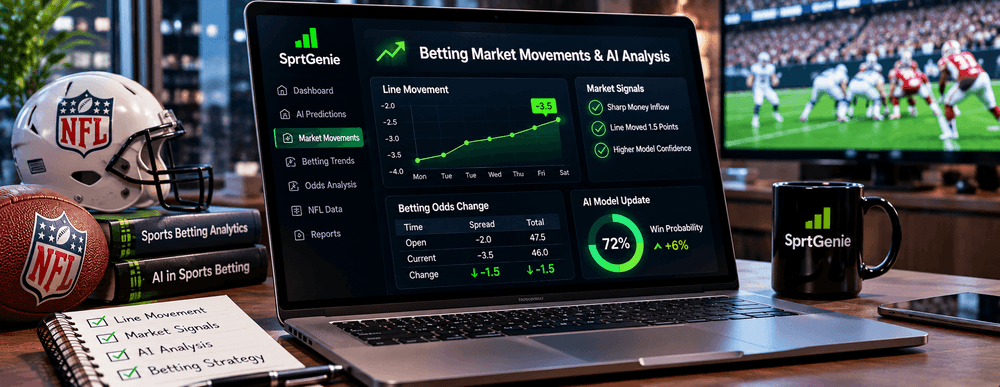
How Betting Market Movements Can Improve AI Sports Analysis
Learn how betting market movement, opening odds, news, and line shifts can inform AI sports analysis without treating every price change as a predictive signal.
How Betting Market Movements Can Improve AI Sports Analysis
Sportsbook lines move because information, demand, and risk change. An opening moneyline may be replaced by a different number after an injury report, while a point spread can shift even when the price attached to it looks familiar. Betting market movement is useful research context, not a reliable standalone signal of who will win. This guide examines line movement sports betting across moneylines, totals, spreads, and props, then explains how AI betting market analysis can incorporate time-stamped market information without accidentally using future data. Distinguishing genuine changes from stale quotes and comparing equivalent markets are essential to interpreting any apparent shift.
What Causes Betting Market Movement?
Opening Lines, Current Lines, and Closing Lines
Opening, current and closing lines refer to prices observed at different timestamps. An opening number may reflect an initial trading view; later quotes respond to market activity and new information. Comparing snapshots only works when the same outcome and exact threshold are recorded. A spread changing from -3 to -3.5 is a different contract, not merely a different payout.
Injuries, Weather, Lineups, and Information Shocks
A quarterback downgrade, starting-lineup change, weather alert or verified injury report may trigger repricing. The useful research question is what became known and when. Rumors, confirmed announcements and late official status reports have different evidentiary value. A market may already reflect an announcement before a casual reader sees it.
Liquidity, Limits, and Bookmaker Adjustments
Betting limits, liquidity and operator risk policies affect movements. A small, lightly traded player prop can shift more sharply than a liquid major-market moneyline without implying that one move is more informative. Sportsbooks do not necessarily update simultaneously; differences between snapshots can reflect refresh timing instead of changing beliefs.
Reading Line Movement Across Sports
Moneyline Changes and Implied Probability
A move from -110 to -135 changes raw implied probability from 52.38% to 57.45%, an increase of about 5.07 percentage points. That change describes the price demanded at each observation. It does not independently prove that the true probability changed by that exact amount, especially because margins may vary.
Spread and Total Movement
A football spread shifting from -3 (-110) to -3.5 (-110) changes the victory-margin outcomes needed to win the wager. A move from -3 (-110) to -3 (-120) preserves the threshold but changes the price. Both types matter, particularly around key scoring margins. Do not mix them into a single 'line moved by half a point' statistic.
Player Prop Market Reactions
Player prop markets react to expected minutes, snaps, usage and confirmed availability. In thin markets, one operator's quote may be stale or more sensitive to individual trading activity. Comparing synchronized timestamps and multiple books can help identify dispersion, but even a broad move is not proof a selection will win.
False Signals and Stale Quotes
Stale feeds can manufacture apparent arbitrage or predictive signals. A price can remain visible after a market suspension, while another data provider has already updated. Separately record timestamp, source, current line and market status. An attractive old quote is not necessarily executable.
Worked Example and Reference Tables
| Recorded market change | Interpretation | Important caveat |
|---|---|---|
| Moneyline -110 → -135 | Higher price-implied chance | Margin and news may differ |
| Spread -3 → -3.5 | New winning threshold | Key margin crossing |
| Spread -3 (-110) → -3 (-120) | Same threshold, worse price | Comparable market |
| Prop 24.5 → 25.5 | New prop threshold | Check player status and liquidity |
| Moneyline snapshot | Price | Implied probability |
|---|---|---|
| Opening | -110 | 52.38% |
| Current | -135 | 57.45% |
| Change | — | +5.07 percentage points |
Using AI Betting Market Analysis Responsibly
Features That Capture Market Context
A responsible market-data feature set includes opening-to-current change, dispersion across sportsbooks, velocity of moves, timestamp relative to news, and repeated quote freshness checks. These variables can help explain market context. They should be added only if the model would really have known them when the prediction was made.
Avoid Look-Ahead Bias
Look-ahead bias occurs when training uses future closing prices or reports that were unavailable when a historical forecast supposedly occurred. A backtest that quietly uses those inputs exaggerates accuracy. Chronological train/test splits and recorded data snapshots are necessary to make AI betting market analysis credible.
Distinguish Prediction From Explanation
Price movement may be a useful covariate without demonstrating causation. A line can move because of news, order flow, risk management or market noise. Models should test whether movement improves out-of-sample calibration beyond existing features, not assume that following a move creates free value.
Practical Market-Movement Research Workflow
Compare Equivalent Markets and Timestamps
First establish the matchup, selection, market type, point threshold, sportsbook and time of quote. For every later observation, capture the same fields. A change between mismatched contracts should be logged as a change of market terms, not a simple odds difference.
Read Movements Alongside SprtGenie Probability
When using SprtGenie, compare the model probability and its last-update time with current prices. If the price has moved after the model calculation, the displayed edge may be outdated. Reassess injury information and the actual available number rather than relying on a screenshot without a timestamp.
Measure Over Time
Over many records, evaluate whether movement-related features improve calibrated probabilities and sensible outcome metrics on held-out samples. Compare with a baseline model without those features. Include losing cases and false signals; cherry-picked examples of dramatic moves tell little about repeatable value.
Market movements are evidence of changing prices, not instructions about what to select. Disciplined analysis starts with equivalent markets, verified information and chronological testing.
Practical Case Study
Imagine an NFL market recorded at 10 a.m. with a fictional favorite priced -110. At 1 p.m., a verified injury report identifies a starting quarterback as unavailable, and the favorite is now -135. Raw implied chance has moved from 52.38% to 57.45%. That difference might reflect changed team strength, a different bookmaker margin, or both. The timestamped event supports an explanation, but it does not prove the market is fully efficient or that a later bet is attractive.
A study of line movement should maintain a sequence rather than just before-and-after numbers. Store the original quote, subsequent quotes, injury report issuance, model updates, and whether each price was executable. Then compare outcomes over many events with similar features against a model that ignores movement. If both models perform similarly on held-out games, the movement feature may add little predictive value. Market stories are easy to tell after kickoff; genuine research has to work with information available beforehand.
FAQ:
1. What is betting market movement?
Betting market movement is a change in offered sportsbook odds, spread, total or related price over time. It can reflect news, trading activity, limits and operator adjustments. The direction alone does not reveal the actual outcome probability or predict the winner.
2. What is line movement sports betting?
Line movement sports betting refers to changes between recorded market snapshots. A spread shifting from -3 to -3.5 changes the winning threshold; a moneyline shifting from -110 to -135 changes payout. Timestamps and matching market definitions are essential.
3. Why do sportsbook lines move?
Injuries, lineups, weather, new information, liquidity, wagering patterns and bookmaker risk policies can all influence pricing. Different operators also refresh at different speeds. A move is an observable market event, but its cause may be uncertain.
4. Does a line shift predict the winner?
No. A shift can reflect information or demand without proving which side will win. Even prices incorporating useful information are imperfect. Claims that 'the smart money moved' should be treated skeptically unless supported by verified, time-stamped evidence.
5. How do moneyline moves affect implied probability?
Convert each quoted price into implied probability. -110 implies 52.38%, while -135 implies about 57.45%. That is a price-implied change of roughly 5.07 percentage points. It should not automatically be equated with an identical change in true win probability.
6. Why do point-spread moves matter?
Point-spread moves can alter which margins lead to a win, loss or push. Movement across -3 to -3.5 can matter more than a small price adjustment at an unchanged spread. Analysts should record both line and attached odds.
7. How can AI betting market analysis use historical odds?
Historical opening, current and closing odds can provide model features when their original timestamps are preserved. AI betting market analysis must avoid using information published after the prediction it purports to evaluate, or backtests will be contaminated by look-ahead bias.
8. What is a stale odds quote?
A stale quote is a price still shown despite newer market information or a suspended market. It can create misleading comparisons, including apparent opportunities that were not actually available. Cross-check sportsbook, timestamp and market status before interpreting differences.
9. Can injury news explain rapid price changes?
Yes, confirmed injury news often changes projected team strength or player usage. But the price may move before the most visible report circulates. Verify the report timing and compare model updates with the sportsbook's quote history rather than assuming causation.
10. How should market movement be evaluated over time?
Evaluate line movement on many pre-recorded events with equivalent markets, synchronized timestamps and out-of-sample performance tests. Compare a model using movement data with one that does not. Avoid drawing conclusions from isolated dramatic moves or selected winners.
SprtGenie provides research and analytics, not a sportsbook or a guarantee of outcomes. Sports betting involves financial risk. 18+; follow applicable laws and responsible-gambling safeguards.