
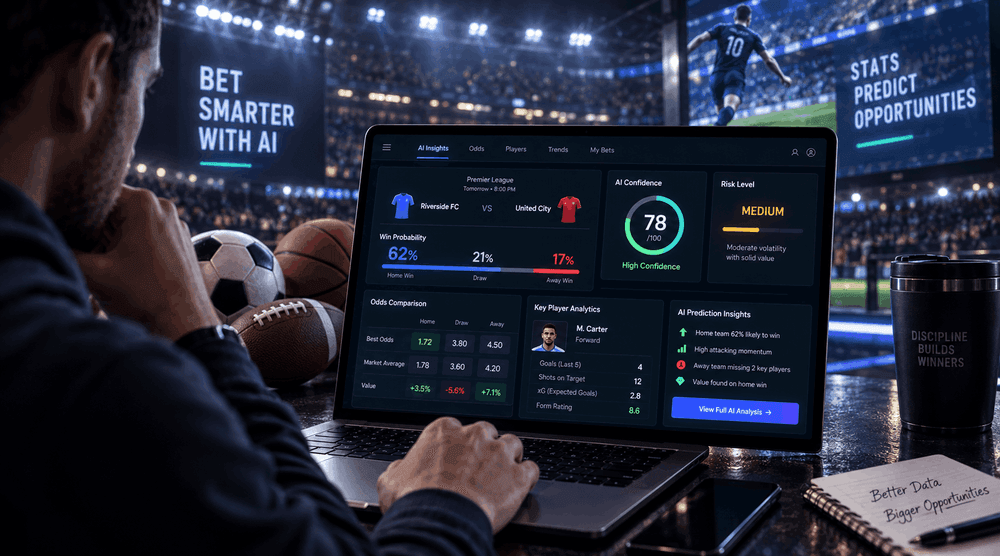
How AI Sports Betting Predictions Work: Data, Machine Learning & Smarter Picks
Learn how AI sports predictions use real-time data, machine learning, sportsbook odds, and probability models to generate smarter, data-driven betting insights.
Sports betting has changed dramatically in recent years. Bettors once relied mostly on experience,
basic statistics, expert opinions, and intuition. Today, artificial intelligence can process far
larger amounts of information and turn that data into probability-based insights.
AI does not remove uncertainty from sports, and it cannot guarantee winning bets. What it can do is
analyze historical and real-time data, identify patterns, compare multiple variables at once, and
update predictions when new information becomes available.
For bettors who want a more structured and analytical approach, understanding how AI sports betting
works is becoming increasingly important.
What Are AI Sports Betting Predictions?
AI sports betting predictions are estimates generated by statistical models and machine learning
algorithms. These systems analyze relevant sports and market data to estimate the likelihood of
different outcomes.
Depending on the sport, league, and type of bet, an AI model may evaluate:
- historical game results;
- team performance;
- player statistics;
- injuries and suspensions;
- expected and confirmed lineups;
- home and away performance;
- rest days and travel schedules;
- weather conditions;
- sportsbook odds;
- betting line movement;
- real-time game information.
The goal is not simply to answer the question, “Who is most likely to win?”
A more useful AI betting system tries to estimate probability and compare that probability with the
price available in the betting market. That distinction matters because the most likely outcome is
not always the best betting opportunity.
AI Predictions vs. Traditional Sports Handicapping
Traditional sports handicapping usually combines statistical research with human judgment.
A bettor may look at recent form, injuries, matchup history, coaching decisions, and situational
factors before making a pick.
AI takes a different approach.
Instead of manually evaluating a limited set of variables, a machine learning model can process
thousands of data points in a consistent way. It may analyze offensive and defensive efficiency,
player performance, injuries, rest, travel, market movement, and many other factors at the same time.
This does not mean human analysis is no longer useful.
Human experts may notice contextual factors that are difficult to quantify, such as coaching changes,
locker-room issues, tactical adjustments, or unusual game circumstances.
AI is best viewed as a decision-support tool that can complement human judgment with data-driven analysis.
How Does AI Sports Betting Work?
At a high level, AI sports betting follows a relatively simple process:
Data → Processing → Model → Probability → Betting Insight
Each stage matters.
A sophisticated machine learning model cannot produce reliable predictions if the underlying data is
inaccurate, incomplete, or outdated.
Step 1: Collecting Sports Data
AI models depend on data.
The quality of the input directly affects the quality of the output.
Common sources of sports data include:
- previous game results;
- player and team statistics;
- scoring trends;
- possession and efficiency metrics;
- injuries;
- lineups;
- home-field advantage;
- rest periods;
- travel schedules;
- weather;
- sportsbook odds.
Different sports require different data.
For example, an NFL prediction model may place significant weight on quarterback performance,
injuries, offensive and defensive efficiency, turnovers, and weather.
An MLB model may focus more heavily on starting pitchers, bullpen strength, batting splits,
ballpark factors, and recent workload.
An NBA model may analyze pace, player availability, rotations, offensive efficiency, and
back-to-back schedules.
The model needs to understand the factors that matter most for the specific sport and market being predicted.
Step 2: Cleaning and Preparing the Data
Raw sports data usually cannot be used immediately.
Before the model can analyze it, the information must often be cleaned, organized, standardized,
and transformed.
This process may include:
- removing duplicate records;
- correcting inconsistent formats;
- handling missing values;
- standardizing categories;
- normalizing statistical ranges;
- transforming raw numbers into meaningful variables.
These variables are often called features.
Examples of features might include:
- average points per game;
- offensive rating;
- defensive rating;
- turnover rate;
- player usage;
- recent shooting percentage;
- days of rest;
- expected starting lineup;
- home versus away performance.
Feature selection is critical.
A model is not automatically better because it uses more data. It needs relevant data that actually
helps explain or predict the outcome.
How Machine Learning Sports Predictions Work
Machine learning sports predictions are created by training algorithms on historical data.
The model learns relationships between different variables and past outcomes, then applies those
relationships to future games.
A simplified process looks like this:
- Historical sports data is collected.
- The data is divided into training and testing sets.
- The model looks for relationships between variables and outcomes.
- It produces predictions.
- Those predictions are compared with actual results.
- The model adjusts its parameters.
- Performance is evaluated on data the model has not previously seen.
Testing on unseen data is especially important.
A model may perform extremely well on historical data simply because it has learned those results too
A useful prediction model should be able to perform consistently on new events, not just explain what
has already happened.
Common Types of Sports Prediction Models
Different machine learning approaches can be used depending on the prediction task.
Logistic Regression
Logistic regression is commonly used when predicting binary outcomes, such as whether one team will
win or lose.
It can estimate probabilities and is relatively easy to interpret.
Decision Trees
Decision trees make predictions by dividing data according to different conditions.
For example, a model may evaluate whether a team is playing at home, whether a key player is available,
and how the opponent has performed recently.
Random Forests
Random forests combine multiple decision trees.
Instead of relying on one set of rules, the model aggregates predictions from many trees, which can
improve stability.
Gradient Boosting
Gradient boosting models build predictions in stages.
Each new model focuses on correcting errors made by the previous model. This technique can perform
well with structured sports datasets.
Neural Networks
Neural networks can identify complex nonlinear relationships between variables.
They can be powerful, but they often require large datasets and careful tuning.
Ensemble Models
Some prediction platforms combine several models rather than relying on a single algorithm.
One model may perform better for certain types of games or markets, while another may capture
different patterns. Combining them can create a more robust prediction system.
What Data Does AI Analyze Before a Game?
AI systems can evaluate several categories of information before making a prediction.
Team Performance
Team-level metrics may include:
- wins and losses;
- scoring efficiency;
- points allowed;
- pace;
- possession statistics;
- offensive rating;
- defensive rating;
- recent form;
- home and away performance.
These metrics help estimate a team's overall strength and style of play.
Player-Level Data
Individual players can have a major influence on game outcomes.
AI systems may analyze:
- recent performance;
- playing time;
- efficiency;
- injuries;
- usage rate;
- expected role;
- matchup history;
- on/off statistics.
A model may substantially change its prediction if a high-impact player is ruled out.
Injuries and Lineup Changes
Injuries are one of the most important sources of new information.
Losing a starting quarterback, goalkeeper, pitcher, or high-usage basketball player can significantly
change the expected performance of a team.
AI platforms that receive updated injury and lineup data can revise predictions as new information
becomes available.
Schedule and Situational Factors
The model may also consider context.
Examples include:
- back-to-back games;
- travel distance;
- rest days;
- playoff implications;
- tournament importance;
- home-field advantage;
- altitude;
- schedule difficulty.
Individually, some of these variables may seem minor. Together, they can influence expected performance.
Why Real-Time Data Matters for AI Sports Predictions
Sports information changes quickly.
A prediction made the day before a game may become less useful if a key player is ruled out shortly
before kickoff.
Real-time or near-real-time data can include:
- confirmed lineups;
- injuries;
- player scratches;
- weather updates;
- sportsbook odds;
- betting line movement;
- live game statistics.
When an AI system processes new information quickly, it can update its probability estimates.
This is one of the major advantages of modern AI-based betting analysis.
Pre-Game Data vs. Real-Time Data
Pre-game models use the information available before the event begins.
They may analyze:
- historical statistics;
- injuries;
- expected lineups;
- previous matchups;
- market odds;
- team form.
Real-time systems can go further.
Once the game starts, the model may incorporate:
- current score;
- possession;
- player performance;
- fouls;
- injuries;
- pace;
- game clock;
- live sportsbook odds.
The result is a prediction that can change as the game develops.
How Sportsbook Odds Become Part of AI Analysis
Sportsbook odds contain useful information.
They do not only represent the potential payout. They also reflect how the betting market prices
the probability of an outcome.
AI systems may analyze:
- opening odds;
- current odds;
- line movement;
- implied probability;
- market consensus.
Betting odds can be converted into an implied probability.
This allows bettors to compare two different estimates:
AI model probability vs. sportsbook implied probability
For example, imagine an AI model estimates that a team has a 60% chance of winning.
If the sportsbook odds imply a 50% probability, the model may see a potential difference between its
estimate and the market price.
That does not mean the bet will win. It simply means the model believes the outcome may be priced
differently from its estimated probability.
From Prediction Probability to a Betting Pick
One of the most important concepts in data-driven sports betting is that probability and betting value
are not the same thing.
Suppose a model gives Team A a 70% chance of winning.
That may sound like a strong prediction.
But if the sportsbook price implies an 80% probability, the bet may not offer attractive value despite
Team A being the more likely winner.
A more complete process looks like this:
Model Probability → Compare With Sportsbook Probability → Evaluate Potential Value
This is where expected value becomes important.
The question is not only:
“Who is most likely to win?”
It is also:
“Is the available price attractive relative to the estimated probability?”
How AI Generates Confidence Scores and Risk Ratings
Sports prediction platforms often translate complex model outputs into easier-to-understand indicators.
These can include:
- confidence scores;
- win probability;
- risk ratings;
- projected edge;
- expected value.
These indicators help bettors interpret the model without needing to understand every technical
calculation behind it.
However, confidence should never be confused with certainty.
If a model estimates a 75% chance of an outcome occurring, there is still a 25% probability that it
does not occur.
A high-confidence pick can still lose.
That is a normal part of probability-based forecasting.
How AI Can Identify Positive EV Betting Opportunities
Expected value, commonly called EV, is a way of evaluating whether a wager may be favorable over the
long term.
An AI model can compare its estimated probability with the probability implied by sportsbook odds.
Model probability: 58%
Sportsbook implied probability: 50%
The difference may indicate a potential positive expected value opportunity.
This does not mean the bet is guaranteed to win.
Positive EV is a long-term concept. A wager with favorable expected value can still lose, while a
poor-value bet can still win.
The objective is to evaluate whether the price may be favorable relative to the estimated probability.
How AI Predictions React to Betting Line Movement
Sportsbook odds constantly change.
Lines may move because of:
- injury news;
- confirmed lineups;
- professional betting activity;
- public betting volume;
- weather;
- new information;
- market corrections.
AI systems can monitor these movements.
For example, if a sportsbook significantly adjusts a line after a star player is ruled out, both the
model's predicted probability and the market price may change.
An AI system that uses real-time information can reevaluate the situation rather than relying on an
outdated prediction.
AI Predictions Across Different Sports
AI prediction models need to be adapted to the sport they analyze.
The same variables do not matter equally in every league.
AI NFL Predictions
NFL models may consider:
- quarterback performance;
- offensive efficiency;
- defensive efficiency;
- injuries;
- turnovers;
- weather;
- matchup data;
- home-field advantage.
Quarterback availability can significantly affect the probability of an outcome.
AI NBA Predictions
NBA models may analyze:
- pace;
- offensive rating;
- defensive rating;
- player availability;
- rotations;
- rest;
- back-to-back schedules;
- recent performance.
Because player availability changes frequently, lineup information can be especially important in basketball.
AI MLB Predictions
Baseball prediction models may consider:
- starting pitchers;
- bullpen strength;
- batting splits;
- recent pitcher workload;
- ballpark factors;
- weather;
- team hitting performance.
Pitching matchups often have a major influence on game probabilities.
AI Soccer Predictions
Soccer models may evaluate:
- expected goals;
- shot quality;
- possession;
- recent form;
- injuries;
- expected lineups;
- home advantage;
- defensive performance.
Expected goals, or xG, is frequently used because it evaluates the quality of scoring opportunities
rather than only the final score.
How Accurate Are AI Sports Predictions?
No AI model can predict sports perfectly.
Sports contain randomness and unexpected events that cannot always be modeled accurately.
Examples include:
- injuries during a game;
- referee decisions;
- turnovers;
- unusual player performances;
- weather changes;
- red cards;
- overtime;
- small sample sizes.
This is why AI predictions should be evaluated over a large number of events.
A single winning prediction does not prove that a model is excellent.
A single losing prediction does not prove that the model is poor.
The important question is how the system performs over time.
Metrics Used to Evaluate AI Prediction Models
Several metrics can help evaluate the quality of sports predictions.
Prediction Accuracy
Accuracy measures how often the model predicts the correct outcome.
It is useful, but it does not tell the whole story.
A model can have a high win rate while still performing poorly from a betting perspective if the odds
are unfavorable.
Calibration
Calibration measures whether predicted probabilities reflect actual outcomes.
If a model assigns 70% probability to many similar events, roughly 70% of those events should occur
over a sufficiently large sample.
Return on Investment
ROI measures betting returns relative to the amount wagered.
It provides a more direct measure of financial performance than simple prediction accuracy.
Closing Line Value
Closing Line Value, or CLV, compares the odds available when a bet was placed with the final market
odds before the event started.
Consistently getting a better price than the closing market can be a useful indicator that a betting
process is identifying value.
Can AI Guarantee Winning Sports Bets?
No.
Artificial intelligence cannot guarantee winning sports bets.
It can improve the speed and consistency of analysis, but it cannot eliminate uncertainty.
Claims of guaranteed winners, risk-free bets, or 100% accurate sports predictions should be treated cautiously.
AI is more useful as an analytical tool.
It can help bettors:
- process large amounts of information;
- compare probabilities;
- track changing markets;
- identify statistical patterns;
- evaluate potential value;
- make more structured decisions.
The final outcome of a sporting event remains uncertain.
AI Sports Predictions vs. Expert Picks
AI predictions and expert picks have different strengths.
AI is especially effective at:
- processing large datasets;
- comparing many variables simultaneously;
- applying the same methodology consistently;
- reacting quickly to new data;
- reducing some forms of emotional bias.
Human experts may be better at:
- interpreting unusual situations;
- understanding coaching decisions;
- evaluating qualitative information;
- recognizing context that is difficult to quantify.
The two approaches do not necessarily compete.
A bettor may use AI-generated probabilities as one part of a broader research process that also
includes market analysis and human judgment.
How SprtGenie Helps Turn Sports Data Into Betting Insights
SprtGenie is designed to help bettors approach sports analysis from a more data-driven perspective.
Instead of evaluating only a single prediction, users can consider multiple types of information
when reviewing a potential betting opportunity.
Depending on the available market and sport, this may include:
- AI-powered predictions;
- probability estimates;
- confidence indicators;
- risk information;
- sportsbook odds;
- real-time market data;
- player prop analysis;
- live betting insights.
Bringing these elements together can make complex sports and betting data easier to interpret.
The purpose is not to eliminate risk or guarantee results. It is to provide more structured
information that bettors can use when making their own decisions.
Final Thoughts: AI Makes Betting Analysis Smarter, Not Certain
AI sports predictions combine historical statistics, machine learning, real-time information,
sportsbook odds, and probability analysis.
Their biggest advantage is not perfect forecasting.
It is the ability to process large amounts of information consistently and update predictions when
circumstances change.
For bettors, this can create a more disciplined way to evaluate sports markets.
Instead of relying only on instinct or following a pick without context, bettors can compare
probabilities, odds, market movements, risk indicators, and other relevant data.
AI can make sports betting analysis more informed. It cannot make sports predictable.
Frequently Asked Questions
How do AI sports betting predictions work?
AI sports betting predictions use statistical models and machine learning algorithms to analyze
historical and current sports data. The system identifies patterns and estimates the probability
of different outcomes.
What data does AI use for sports predictions?
AI models may use team statistics, player performance, injuries, lineups, historical results,
schedules, weather, sportsbook odds, and real-time information.
How does machine learning predict sports results?
Machine learning models are trained on historical data to identify relationships between different
variables and actual outcomes. They then apply those patterns to new events to estimate probabilities.
Are AI sports predictions accurate?
AI can produce useful probability estimates, but no sports prediction model is perfectly accurate.
Sporting events include randomness and unexpected circumstances.
Can AI guarantee winning sports bets?
No. AI cannot guarantee a winning bet or eliminate betting risk. It should be used as an analytical
and decision-support tool.
Can AI predictions change before a game?
Yes. Predictions may change when new information becomes available, including injuries, confirmed
lineups, weather updates, or sportsbook line movement.
Does AI analyze sportsbook odds?
Many sports betting models use sportsbook odds, implied probabilities, and line movement as part
of their analysis.
What is the difference between AI probability and sportsbook probability?
AI probability is the prediction model's estimate of how likely an outcome is. Sportsbook implied
probability is derived from the betting odds offered by the bookmaker.
Are machine learning sports predictions better than expert picks?
Not necessarily. Machine learning can process large datasets consistently, while human experts may
understand qualitative context that is difficult for a model to quantify. Both approaches can
complement each other.
Can AI be used for live sports betting?
Yes. AI systems that process real-time game and market data can update probabilities and insights
as conditions change during an event.