
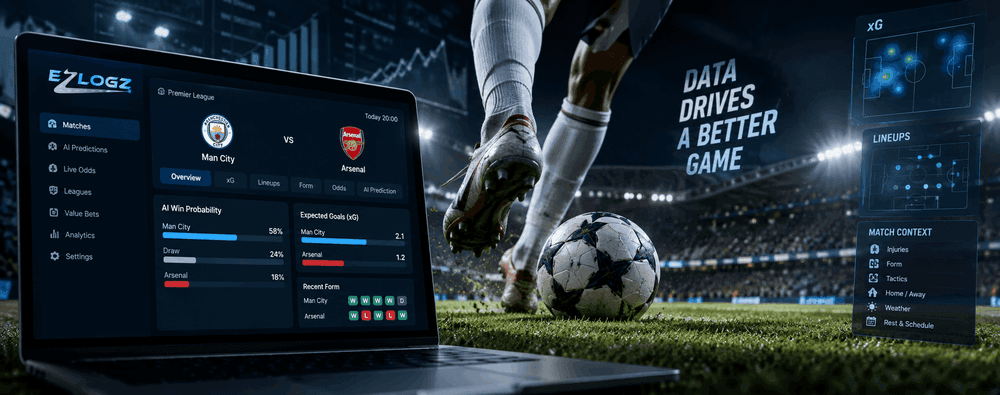
How AI Soccer Predictions Use xG, Form & Lineups
Soccer is one of the most difficult sports to predict.
Matches are low-scoring, individual moments can have an outsized impact, and the final score does not always reflect how well each team actually played.
A team can dominate possession, create the better chances, and still lose 1–0. Another team can score from two low-quality chances and appear stronger than the underlying performance suggests.
That is why modern AI soccer predictions go beyond basic statistics such as league position, goals scored, or recent wins and losses.
A stronger prediction model may combine:
- Expected goals (xG)
- Expected goals against (xGA)
- Recent form
- Starting lineups
- Injuries and suspensions
- Home and away performance
- Tactical matchups
- Rest and fixture congestion
- Player-level data
- Match importance
- Real-time sportsbook odds
The goal is not to create certainty.
AI soccer predictions estimate probabilities by combining multiple signals and updating those estimates as new information becomes available.
This article explains how those signals work together and why xG, form, lineups, and match context can make soccer prediction models more informative.
How Do AI Soccer Predictions Work?
AI soccer prediction models analyze historical and current information to estimate the probability of different match outcomes.
A simplified process may look like this:
- Collect historical team and player data.
- Measure attacking and defensive performance.
- Analyze recent form and opponent strength.
- Adjust for injuries, suspensions, and expected lineups.
- Consider home advantage, rest, travel, and tactical matchups.
- Estimate probabilities for different outcomes.
- Compare those probabilities with current sportsbook prices.
Different models use different inputs and methodologies, but the underlying idea is similar: combine relevant data into a structured probability estimate.
| Model Input | What It Helps Estimate |
|---|---|
| xG and xGA | Chance quality and attacking/defensive strength |
| Recent form | Current level of performance |
| Starting lineups | Expected player quality and tactical setup |
| Injuries and suspensions | Impact of missing players |
| Home/away data | Venue-specific performance |
| Tactical matchup | How playing styles interact |
| Rest and schedule | Fatigue and rotation risk |
| Match context | Competition situation and incentives |
| Sportsbook odds | Market expectations and potential value |
No single variable should be treated as a complete prediction on its own.
The value comes from combining them.
What Is xG in Soccer?
Expected goals, usually shortened to xG, is a statistical measure that estimates the likelihood that a scoring chance will become a goal.
Instead of treating every shot equally, xG attempts to measure the quality of the opportunity.
A close-range shot in front of goal is generally more valuable than a long-distance attempt from a difficult angle.
Depending on the model, xG may consider factors such as:
- Shot location
- Shot angle
- Type of assist
- Whether the shot was a header or taken with the foot
- Open play or set piece
- Defensive pressure
- Type of attacking sequence
Each attempt receives a probability value.
For example:
A low-quality shot might have an xG of:
0.05
A strong one-on-one chance might be:
0.45
A penalty usually carries a much higher expected scoring probability.
The total xG for a team represents the combined quality of its chances.
Why xG Matters More Than the Final Score Alone
Final scores can be misleading.
Consider a hypothetical match:
Team A 2–0 Team B
At first glance, Team A appears to have dominated.
But the underlying numbers show:
Team A xG: 0.9
Team B xG: 2.1
The result and the chance quality tell different stories.
Team A may have finished its chances extremely efficiently, while Team B created better opportunities but failed to convert them.
For prediction models, that difference matters.
A model based only on results might see a convincing 2–0 win.
A model using xG may interpret the match as less dominant and adjust future expectations accordingly.
xG vs. Actual Goals
The two metrics answer different questions.
| Metric | What It Shows |
|---|---|
| Goals | What actually happened |
| xG | Quality of scoring opportunities created |
| xGA | Quality of opportunities conceded |
| xG difference | Balance between attacking and defensive performance |
Actual goals remain important, but xG can help reveal whether recent results are supported by sustainable underlying performance.
For example, a team that repeatedly scores three goals from one expected goal may be outperforming its chance quality.
That could be driven by:
- Excellent finishing
- Exceptional individual players
- Short-term variance
- Opponent errors
AI models can examine whether that finishing performance appears sustainable or whether results may begin moving closer to the underlying xG numbers.
How AI Uses xG Over Multiple Matches
One match is a very small sample.
AI models generally gain more useful information by analyzing xG across multiple games.
Useful measures may include:
- Average xG created
- Average xG conceded
- xG difference
- Rolling five-match xG
- Rolling ten-match xG
- Home xG
- Away xG
- xG against strong opponents
- xG against weak opponents
This helps distinguish short-term noise from longer-term performance.
A team may have won four of its last five matches, but if it has consistently been outperformed on xG, the results may be less convincing than the record suggests.
On the other hand, a team with several recent losses may still be creating high-quality chances and conceding relatively little xG.
That team may be performing better than its recent results indicate.
What Is xGA?
Expected goals against, or xGA, measures the quality of chances a team allows its opponents to create.
xG looks at attacking performance.
xGA looks at defensive performance.
A team that consistently has:
High xG + Low xGA
may have a strong underlying performance profile.
A team with:
Low xG + High xGA
may be struggling at both ends of the pitch.
AI models can use the relationship between xG and xGA to estimate relative team strength more accurately than by looking at goals alone.
Why Recent Form Still Matters
xG is valuable, but soccer prediction models should not ignore recent form.
Teams change.
A club may improve after:
- A managerial change
- Tactical adjustments
- Players returning from injury
- A new signing
- A formation change
- Improved fitness
A previously strong team may decline because of:
- Injuries
- Fixture congestion
- Loss of confidence
- Tactical problems
- Player departures
- Defensive instability
AI can use recent form to give more weight to current conditions.
Results-Based Form vs. Performance-Based Form
A basic form table may show:
W-W-D-W-L
That is useful, but it does not explain the quality of those performances.
A more advanced model may break form into several dimensions.
| Form Type | Example |
|---|---|
| Results-based form | Wins, draws, and losses |
| Goal-based form | Goals scored and conceded |
| xG-based form | Expected goals created and allowed |
| Shot-based form | Shot volume and shot quality |
| Opponent-adjusted form | Performance weighted by opponent strength |
| Venue-adjusted form | Home and away form analyzed separately |
Suppose Team A has won five straight matches.
That sounds excellent.
But if four of those matches were against relegation-level opponents, the result may deserve less weight than five strong performances against top competition.
AI can account for opponent quality instead of treating every win equally.
Why Opponent Strength Matters
Recent form should always be interpreted in context.
Compare two hypothetical teams:
Team A: W-W-W-W-W
Team B: W-D-W-L-W
Team A appears much stronger based on results.
But now add opponent quality.
Team A played five bottom-half teams.
Team B played four title contenders and one mid-table team.
The form records are no longer directly comparable.
AI models can adjust performance based on the quality of the opposition.
This helps prevent overrating teams that have benefited from easier schedules.
Starting Lineups Can Change a Prediction
Season-long team statistics assume a relatively stable level of team strength.
But actual match strength depends heavily on who is available.
A team missing its best striker, goalkeeper, or creative midfielder may be significantly weaker than its season average suggests.
That is why starting lineups are critical in soccer prediction models.
AI may consider the availability of:
- Goalkeepers
- Center backs
- Fullbacks
- Defensive midfielders
- Creative midfielders
- Wingers
- Strikers
- Set-piece specialists
The absence of one player can change both team quality and tactical structure.
Not Every Missing Player Has the Same Impact
Injuries and suspensions should not be counted equally.
A starting striker who scores 30% of a team's goals is more important than a reserve player who averages 10 minutes per match.
| Missing Player | Possible Model Impact |
|---|---|
| Starting goalkeeper | Defensive probability adjustment |
| Key center back | Greater opponent scoring probability |
| Defensive midfielder | Reduced defensive stability |
| Creative midfielder | Lower chance creation |
| Leading striker | Lower scoring probability |
| Set-piece specialist | Reduced dead-ball threat |
| Rotation player | Smaller adjustment |
The quality of the replacement matters as well.
If a top striker is unavailable but the backup is nearly as productive, the impact may be limited.
If the drop-off is large, the model may make a stronger adjustment.
Expected Lineups vs. Confirmed Lineups
Before a match, models usually work with expected lineups.
These are based on:
- Recent selections
- Injury reports
- Rotation patterns
- Tactical preferences
- Competition priorities
But expected lineups contain uncertainty.
Once official lineups are announced, the model can use confirmed information.
This may change:
- Win probabilities
- Goal expectations
- Player prop probabilities
- Confidence levels
- Market value
That is why soccer predictions can change in the final hour before kickoff.
A model using confirmed lineups has more accurate information than one relying only on projections.
Injuries and Suspensions
Injuries are one of the most important real-time inputs in soccer analysis.
They can affect:
- Team quality
- Formation
- Tactical style
- Defensive structure
- Chance creation
- Set pieces
- Bench depth
Suspensions can have a similar effect.
A model should ideally evaluate not just the number of missing players, but their individual importance and available replacements.
Three missing rotation players may have less impact than one missing elite goalkeeper or central playmaker.
How Home and Away Performance Affects Predictions
Home advantage remains an important factor in soccer.
Teams may perform differently at home because of:
- Familiar surroundings
- Reduced travel
- Crowd support
- Tactical confidence
- Pitch familiarity
Models may compare:
- Home xG
- Away xG
- Home xGA
- Away xGA
- Home goals
- Away goals
- Points per home game
- Points per away game
But home advantage is not identical for every club.
Some teams perform much better at home.
Others show relatively little difference.
AI can estimate team-specific home and away effects instead of applying one universal adjustment.
Tactical Matchups Matter
Soccer is not simply a comparison of overall team ratings.
Playing styles interact.
A team can perform well against one type of opponent and struggle against another.
For example:
| Team Style | Potential Matchup Issue |
|---|---|
| High defensive line | Vulnerable to fast counterattacks |
| High press | May trouble teams weak in buildup |
| Low defensive block | Can frustrate possession-heavy teams |
| Narrow formation | May be exposed by wide attacks |
| Aggressive fullbacks | Can leave space behind |
| Set-piece strength | Valuable against weak aerial defenses |
These interactions are difficult to represent with simple league tables.
Advanced models may use tactical or event-level data to estimate how specific styles match up.
Match Context Can Change Team Behavior
The same two teams can produce different match probabilities depending on the situation.
A regular league match is not the same as:
- A cup final
- A relegation battle
- A title-deciding match
- A Champions League second leg
- A must-win group game
- A match where one team has already qualified
Match context can influence:
- Tactical risk
- Rotation
- Tempo
- Defensive approach
- Substitution strategy
For example, a team leading by two goals after the first leg of a knockout tie may play more conservatively in the second leg.
The quality of the teams has not changed.
The strategic context has.
First Leg vs. Second Leg
Knockout football is a good example of why context matters.
In a first leg, teams may prioritize avoiding mistakes.
In a second leg, the aggregate score can radically change strategy.
A team trailing by two goals may:
- Push more players forward
- Accept greater defensive risk
- Increase shot volume
- Press more aggressively
A team protecting a lead may:
- Defend deeper
- Slow the game
- Prioritize possession
- Reduce attacking risk
A strong AI soccer model should consider aggregate score and match situation when estimating outcomes.
Fixture Congestion and Rest
Soccer teams sometimes play several matches in a short period.
A club may have:
- A league match on Sunday
- European competition on Wednesday
- Another league match on Saturday
This can affect player availability and performance.
Relevant factors may include:
- Days of rest
- Travel distance
- Previous match intensity
- Extra time
- Squad depth
- Rotation
- Player workload
A strong team playing its fourth match in 12 days may deserve a different rating than the same team after a full week of rest.
Travel and Scheduling
Travel can also influence match preparation.
This is especially relevant in:
- International competitions
- Continental tournaments
- Large domestic leagues
- International breaks
Long-distance travel can affect:
- Recovery time
- Sleep
- Training schedule
- Player fatigue
These factors are usually smaller than major team-quality differences, but they can still provide useful context.
Weather and Playing Conditions
Weather is another contextual factor.
Potential conditions include:
- Heavy rain
- Strong wind
- Extreme heat
- Snow
- Poor pitch conditions
These may influence:
- Passing accuracy
- Crossing
- Shooting
- Game speed
- Physical fatigue
For example, strong wind may reduce the accuracy of long passes and crosses.
Heavy rain can change ball speed and pitch conditions.
Weather usually should not dominate a prediction, but it can be a useful adjustment when conditions are extreme.
How AI Uses Player-Level Data
Team-level statistics do not capture everything.
AI models can also use individual player data.
Relevant metrics may include:
- Player xG
- Expected assists (xA)
- Shots
- Shots on target
- Chances created
- Progressive passes
- Defensive actions
- Minutes played
- Usage
- Set-piece involvement
This allows a model to estimate how the presence or absence of specific players changes team strength.
Expected Assists (xA)
Expected assists, or xA, estimates the quality of chances created by a player's passes.
A midfielder may record few actual assists even while consistently creating strong opportunities.
That can happen because teammates fail to finish the chances.
xA helps separate chance creation from finishing.
For prediction models, this can improve the evaluation of creative players whose traditional assist totals may not fully reflect their performance.
AI Soccer Predictions for Different Markets
Soccer prediction models do not need to produce only one match winner.
They can estimate probabilities across many markets.
| Market | What AI May Estimate |
|---|---|
| 1X2 | Home win, draw, away win |
| Moneyline | Probability of selected team winning |
| Draw No Bet | Win probability with draw protection |
| Double Chance | Probability of two combined outcomes |
| Over/Under | Expected total goals |
| Both Teams to Score | Probability both sides score |
| Asian Handicap | Relative team-strength distribution |
| Player props | Shots, goals, assists, and other outcomes |
Different markets require different types of data.
For example, predicting a match winner may depend heavily on overall team strength.
Predicting a player's shots may depend more on:
- Expected minutes
- Role
- Opponent
- Team possession
- Player shot volume
Example of an AI Soccer Prediction
Consider a hypothetical match between a home team and an away team.
| Factor | Home Team | Away Team |
|---|---|---|
| Last 5 xG | 8.4 | 5.9 |
| Last 5 xGA | 4.8 | 7.1 |
| Recent form | W-W-D-W-W | L-W-D-L-W |
| Key absences | None | Starting center back |
| Rest | 6 days | 3 days |
| Venue | Home | Away |
A model might estimate:
Home win: 54%
Draw: 27%
Away win: 19%
These probabilities do not come from one number.
They may reflect a combination of:
- Better recent chance creation
- Stronger defensive xG
- Home advantage
- Greater rest
- Opponent injury
- Recent form
The final prediction is a combined estimate.
Why Real-Time Sportsbook Odds Add Another Layer
Predicting an outcome is only one part of betting analysis.
Price matters too.
Suppose an AI model estimates:
Home win probability: 54%
Now compare that with sportsbook odds.
If the sportsbook price implies:
46%
there may be a meaningful difference between model probability and market price.
If the sportsbook price implies:
58%
the home team may still be the most likely winner, but the available price may not appear favorable.
This is the same logic used in positive EV betting.
A strong betting analysis therefore considers both:
What is likely to happen?
and
Is the available price favorable?
Why Soccer Prediction Models Can Be Wrong
Soccer contains a high level of uncertainty.
Even strong models can miss.
| Limitation | Why It Matters |
|---|---|
| Red cards | Can completely change match dynamics |
| Penalties | High-impact events that are difficult to forecast |
| Finishing variance | Good chances can be missed |
| Goalkeeper performance | Exceptional saves can change results |
| Deflections | Random events can produce goals |
| Tactical surprises | Managers can change strategy unexpectedly |
| Late injuries | Can alter lineups after predictions are made |
| Data quality | Poor data produces weaker estimates |
A model that gives one team a 70% chance of winning still implies a 30% probability that the expected result does not occur.
Probability is not certainty.
Why Draws Are Difficult to Predict
Soccer has an additional complication compared with many sports: the draw.
A prediction model usually needs to estimate three main outcomes:
- Home win
- Draw
- Away win
Low-scoring matches increase the probability that teams finish level.
A 0–0 or 1–1 result can occur even when one team creates somewhat better chances.
This makes soccer prediction more complex than a simple two-outcome model.
How to Evaluate an AI Soccer Prediction Tool
A useful AI soccer prediction platform should provide more than just a pick.
Look for information such as:
| Feature | Why It Matters |
|---|---|
| Probability estimates | Shows how likely the model believes each outcome is |
| xG integration | Adds chance-quality analysis |
| Lineup updates | Reflects actual player availability |
| Injury information | Helps adjust team strength |
| Recent form | Captures current performance |
| Odds timestamps | Shows whether sportsbook prices are current |
| Confidence metrics | Adds context to predictions |
| Risk information | Helps communicate uncertainty |
| Historical results | Allows users to evaluate performance |
| Clear methodology | Helps users understand the model |
Transparency is important.
A platform that only displays “Team A will win” provides less useful information than one showing the probability, context, and current market price.
How SprtGenie Supports AI Soccer Research
SprtGenie is designed to help users research soccer and other sports using AI-powered analysis and sportsbook data.
Relevant capabilities may include:
- AI-generated soccer predictions
- Probability analysis
- Confidence scores
- Risk information
- Real-time sportsbook odds
- Odds comparison
- Live analysis
- SnapTap
- Genie Tap
Instead of relying only on league position or recent scores, users can review a broader set of information and compare model expectations with current market prices.
SprtGenie should be treated as a research and decision-support platform rather than a guarantee of any outcome.
A Simple AI Soccer Prediction Workflow
A structured process can help users analyze matches more consistently.
| Step | What to Review |
|---|---|
| 1 | Match and betting market |
| 2 | xG and xGA |
| 3 | Recent form |
| 4 | Opponent strength |
| 5 | Expected or confirmed lineup |
| 6 | Injuries and suspensions |
| 7 | Home and away performance |
| 8 | Tactical matchup |
| 9 | Rest, travel, and fixture congestion |
| 10 | Match context |
| 11 | AI probability |
| 12 | Current sportsbook odds |
The goal is not to find one perfect statistic.
It is to build a complete view of the match.
Final Thoughts
Good AI soccer predictions are not based on a single number.
They combine multiple layers of information.
A practical model may use:
xG + xGA + recent form + lineups + player availability + tactics + venue + schedule + match context + market data
xG helps measure chance quality.
Form shows how a team has been performing recently.
Lineups reveal who is actually available to play.
Match context explains how strategy may change depending on competition and situation.
AI helps process these variables consistently and convert them into probability estimates.
But soccer will always contain uncertainty.
Red cards, penalties, finishing variance, goalkeeping, and tactical surprises can change a match quickly.
The most useful way to view AI soccer predictions is therefore as probability-based research, not as guaranteed forecasts.
Frequently Asked Questions
What is xG in soccer predictions?
xG, or expected goals, estimates the probability that scoring chances will result in goals. It helps measure chance quality rather than simply counting shots or goals.
How does AI predict soccer matches?
AI models can combine historical results, xG, xGA, recent form, player data, lineups, injuries, tactical information, venue, rest, and other contextual factors to estimate match probabilities.
Is xG better than recent form for predicting soccer?
Neither should be used alone. xG provides insight into chance quality, while recent form helps measure current performance. Strong models can combine both.
Do starting lineups affect AI soccer predictions?
Yes. Confirmed lineups can significantly affect predictions because missing or returning players may change team quality, formation, and tactics.
Can AI predict draws in soccer?
AI can estimate the probability of a draw, but draws can be difficult to predict because soccer is a low-scoring sport and small events can significantly affect the final score.
How do injuries affect soccer prediction models?
Models may adjust team strength based on the importance of the missing player, their role, expected replacement quality, and how the absence affects tactics.
Can AI soccer predictions identify value bets?
AI probabilities can be compared with sportsbook implied probabilities to identify potential model-market differences. However, a potential edge does not guarantee a profitable result.
How accurate are AI soccer predictions?
Accuracy depends on the model, data quality, market, competition, and sample size. No model can predict soccer matches with certainty.
Why do AI soccer predictions change before kickoff?
Predictions may change when confirmed lineups, injury news, weather, tactical information, or sportsbook odds become available.
What data should a good AI soccer prediction model use?
A robust model may consider xG, xGA, recent form, opponent strength, player availability, starting lineups, home and away performance, tactics, schedule, match context, and current market data.