
Can AI Build Better Parlays? How Data, Probability, and Correlation Work
Understand how an AI parlay builder evaluates probabilities, correlated outcomes, same-game parlay pricing, and the limitations of AI parlay picks.
Can AI Build Better Parlays? How Data, Probability, and Correlation Work
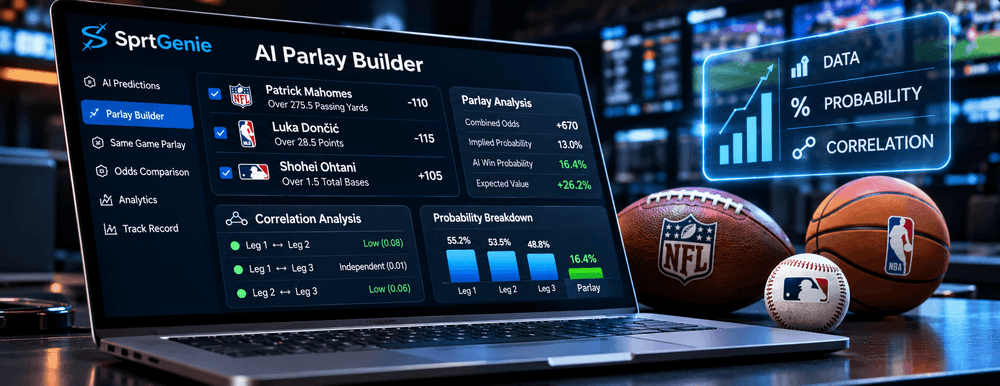
Parlays combine multiple selections into one wager whose result depends on all legs. They may offer a larger quoted payout than a single selection, but the chance that every requirement is met generally falls as legs are added. An ai parlay builder can help organize matchup data, estimate probabilities, and identify links among outcomes. It cannot eliminate the bookmaker margin or make a weak combination strong merely by adding algorithms.
The central problem for ai parlay picks is correlation. Two legs in the same game may rise and fall together, so a shortcut based on multiplying individual probabilities can yield an unrealistic estimate. This article explains the mathematics behind same game parlay predictions and how to use AI as a research aid rather than a guarantee of success.
How an AI Parlay Builder Combines Multiple Predictions
Single-leg estimates are the foundation
Suppose an analysis assigns a 60% probability to one event and 55% to another. If they are independent, the joint probability is 0.60 × 0.55 = 33%. Adding a third independent leg at 50% reduces that probability to 16.5%. The quoted payout may rise, but so does the requirement that all predictions work. Small errors in leg probabilities also compound when they are combined.
Before combining anything, every estimate needs a precise definition: moneyline, spread with its specified number, a points total, or a player prop with a particular threshold. A -110 spread and a +100 moneyline are different events. Alternative markets, pushes, and voided legs can further change settlement and should not be ignored.
Why independence is a strong assumption
Independence means learning that one leg succeeded does not change the probability of another. That is rarely assured for same-game outcomes. If a quarterback throws for 300 yards, a primary receiver may also have elevated receiving-yard chances. Conversely, a low-scoring game may reduce the likelihood that both teams exceed ambitious scoring totals.
Correlation Changes Same-Game Parlay Probabilities
Positive and negative relationships
Positive correlation means two outcomes tend to occur together more frequently than an independence assumption would predict. Negative correlation means one outcome makes the other less likely. Correlation is not proof of causation, and relationships can change with lineups, tactics, and game state. An NFL passing-yards over and a receiving-yards over for a teammate may share a high-volume passing script, but that link is not fixed across matchups.
A numerical example of dependence
Imagine an estimated 60% chance for Leg A and a 50% chance for Leg B. An independence calculation yields a 30% joint probability. However, if the estimated chance of B conditional on A is 65%, their joint probability is 0.60 × 0.65 = 39%. If it is only 35%, the joint probability becomes 21%. Using 30% for all three cases would misprice the relationship.
| Scenario | P(A) | P(B given A) | Joint chance | Meaning |
|---|---|---|---|---|
| Independent | 60% | 50% | 30% | No modeled interaction |
| Positively associated | 60% | 65% | 39% | More outcomes together |
| Negatively associated | 60% | 35% | 21% | Fewer outcomes together |
NBA and NFL scenarios
An NBA star’s assist over and a teammate’s scoring over might depend on team shooting efficiency and shared minutes. Yet the assist count depends on made shots, while teammate scoring can occur without the passer receiving the assist; the connection varies. In football, a leading team might run more often in the fourth quarter, helping running-back attempts while hurting quarterback passing-yard overs. Simple templates do not capture every game script.
How to Evaluate AI Parlay Picks and Offered Odds
Compare a joint probability with the full parlay price
The payout determines the price needed for a combination to break even. Decimal odds of 4.00 imply a 25% break-even probability. If a credible model estimates a 23% joint probability, the expected value is negative, regardless of whether each individual leg looks plausible. At a hypothetical 28% model probability and 4.00 decimal odds, expected profit per $1 stake is 0.28 × 3.00 − 0.72 = $0.12. That is a model-based expectation, not an assured return.
For same-game parlays, sportsbooks often adjust combination prices for correlated legs. Simply multiplying the displayed individual decimal odds may yield a number that is not offered, because the operator recognizes the relationship. Comparison must therefore use an actual available combined quote and its rules.
| Model joint probability | Combined decimal odds | Implied break-even | Expected profit per $1 |
|---|---|---|---|
| 23% | 4.00 | 25% | -$0.08 |
| 25% | 4.00 | 25% | $0.00 |
| 28% | 4.00 | 25% | +$0.12 |
How to test a parlay model responsibly
- Define all legs and settlement rules before estimating probabilities.
- Check injuries, expected workload, and game conditions.
- Use a modeled joint distribution or conditional probabilities where appropriate.
- Compare that estimate with an actual, timestamped parlay quote.
- Stress-test the result under plausible alternative game scripts.
- Evaluate historical results out of sample with accurate transaction prices.
Using SprtGenie as an Analytics Input
SprtGenie provides sports research, published predictions, confidence and risk context, and sportsbook price comparisons. These data points can inform an independent parlay analysis. Its public website does not establish that every parlay combination or correlated-leg model is available as a product feature, so the phrase ai parlay builder here describes a general analytical approach rather than a guaranteed built-in SprtGenie tool.
A sound process rejects the assumption that more legs mean better value. Avoid optimizing solely for a headline payout or chasing losses through larger combinations. Record the market, available price, joint probability assumptions, and realized outcome for each test. The most defensible use of AI is to expose uncertainty and correlation, not to hide them under an impressive combined return.
SprtGenie is for research, not the acceptance or placement of bets. This material is educational, does not promise profits, and is intended for adults 18+ subject to local restrictions.
FAQ:
What does an AI parlay builder do?
It may combine probability estimates for multiple selections and assess the odds and dependencies among those legs.
Are AI parlay picks guaranteed to win?
No. Every additional condition introduces uncertainty, and model estimates can be incorrect.
What is a same-game parlay?
It combines multiple markets from one event; such legs may be statistically dependent.
Why does correlation matter?
Because the success of one leg can change the likelihood of another, invalidating a simple independence calculation.
Can I multiply individual probabilities for a parlay?
Only as an approximation when independence is justified; correlated legs require a joint model.
Does a higher payout mean better value?
No. Value depends on how the implied break-even probability compares with a credible estimate of the joint outcome.
What is negative correlation in an NFL parlay?
A high-scoring passing game and a very low team passing total may work against one another, depending on the defined legs.
Why are same-game parlay odds different from multiplied single odds?
Sportsbooks often adjust prices to account for dependence and market-specific rules.
Can historical parlay wins prove an AI model works?
No. Large out-of-sample samples, actual quoted prices, and transparent reporting are needed.
Does SprtGenie accept parlay wagers?
No. It identifies itself as an analytics and research platform, not a sportsbook.