
American, Decimal and Fractional Odds Explained: A Complete Betting Odds Guide
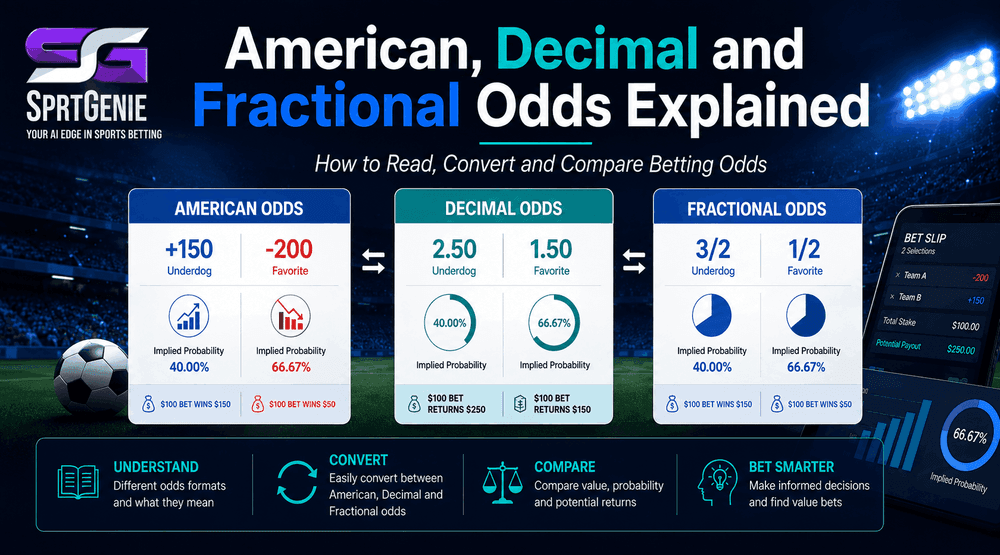
Betting odds can look confusing at first because sportsbooks do not all present prices in the same format. A wager listed as +150 on one platform may appear as 2.50 on another and 3/2 somewhere else.
Although those numbers look different, they represent the same underlying price and approximately the same implied probability. Understanding how American, decimal and fractional odds work makes it easier to calculate potential payouts, compare sportsbook prices and estimate how likely an outcome is according to the betting market. This guide explains all three major odds formats, shows how to convert between them and demonstrates how odds relate to implied probability, sportsbook margins and practical betting research.
What Are Betting Odds?
Betting odds are numerical representations of two connected ideas: the potential return from a wager and the probability assigned to an outcome by the market. For bettors, odds determine how much money can potentially be returned when a prediction is correct. For sportsbooks, odds are also a pricing mechanism used to balance probabilities, market conditions and bookmaker margins. The three most common odds formats are:
- American odds, such as +150 or -200
- Decimal odds, such as 2.50 or 1.50
- Fractional odds, such as 3/2 or 1/2
The format changes how the price is displayed, but not the underlying economics of the bet. For example:
| Odds Format | Example | Approximate Implied Probability |
|---|---|---|
| American | +150 | 40% |
| Decimal | 2.50 | 40% |
| Fractional | 3/2 | 40% |
All three examples represent essentially the same price.
The Three Main Betting Odds Formats
Different regions and sportsbooks have historically preferred different odds formats. American odds are standard across many United States sportsbooks. Decimal odds are common throughout Europe, Canada, Australia and many international markets. Fractional odds remain closely associated with the United Kingdom and Ireland, particularly horse racing.
| Format | Example | How It Is Read |
|---|---|---|
| American | +150 | Potential profit relative to $100 |
| Decimal | 2.50 | Total return per $1 staked |
| Fractional | 3/2 | Profit relative to stake |
The key is understanding what each number is telling you.
American Odds Explained
American odds use positive and negative numbers. Examples include:
- +120
- +150
- +300
- -110
- -150
- -250
The plus or minus sign is important because positive and negative American odds are calculated differently.
How Positive American Odds Work
Positive American odds indicate how much profit a bettor would make from a theoretical $100 stake. For example: +150 means that a successful $100 wager would produce:
- $150 profit
- $100 original stake returned
- $250 total return
The basic formula is: Profit = Stake × (American Odds ÷ 100) Suppose you wager $40 at +150. The calculation is: $40 × 1.50 = $60 profit Your total return would therefore be: $40 + $60 = $100 Positive American odds are frequently associated with underdogs, although the plus sign itself simply describes how the payout is calculated.
How Negative American Odds Work
Negative American odds show how much must theoretically be wagered to earn $100 in profit. For example: -200 means a $200 successful stake would produce:
- $100 profit
- $200 original stake returned
- $300 total return
For smaller stakes, the formula is: Profit = Stake × (100 ÷ Absolute American Odds) Consider a $50 wager at -200. $50 × (100 ÷ 200) = $25 profit The total return is: $50 + $25 = $75 Negative odds commonly appear on favorites because the market assigns the outcome a relatively higher probability.
Positive vs Negative American Odds
The relationship becomes clearer when comparing several prices.
| American Odds | $100 Stake | Profit | Total Return |
|---|---|---|---|
| +200 | $100 | $200 | $300 |
| +150 | $100 | $150 | $250 |
| +100 | $100 | $100 | $200 |
| -150 | $100 | $66.67 | $166.67 |
| -200 | $100 | $50 | $150 |
The farther positive odds move above +100, the larger the potential return and generally the lower the implied probability. For negative odds, a larger absolute number means a smaller profit relative to the stake and usually a higher implied probability.
Decimal Odds Explained
Decimal odds are often considered one of the simplest formats for calculating returns because the displayed number already includes the original stake. Examples include:
- 1.40
- 1.75
- 2.00
- 2.50
- 4.00
The formula is straightforward: Total Return = Stake × Decimal Odds Suppose you place a $100 wager at decimal odds of 2.50. $100 × 2.50 = $250 total return To calculate profit: $250 - $100 = $150 profit This is why decimal odds can be convenient when comparing multiple possible wagers.
How to Read Decimal Odds Quickly
Higher decimal odds generally indicate a larger potential return and a lower implied probability. For example:
| Decimal Odds | $100 Stake | Total Return | Profit |
|---|---|---|---|
| 1.50 | $100 | $150 | $50 |
| 2.00 | $100 | $200 | $100 |
| 2.50 | $100 | $250 | $150 |
| 4.00 | $100 | $400 | $300 |
Decimal odds of 2.00 are especially useful as a reference point because they correspond to even-money odds. In other formats: 2.00 decimal = +100 American = 1/1 fractional
Fractional Odds Explained
Fractional odds express the amount of potential profit relative to the stake. Common examples include:
- 1/2
- 4/5
- 1/1
- 3/2
- 2/1
- 5/1
Consider odds of 3/2. This means that for every $2 staked, the potential profit is $3. If you wager $20: $20 × 3 ÷ 2 = $30 profit The total return is: $20 + $30 = $50 The general formula is: Profit = Stake × Numerator ÷ Denominator Fractional odds have traditionally been popular in UK betting markets and remain particularly visible in horse racing.
What Does “Evens” Mean?
The term evens refers to fractional odds of 1/1. A winning $100 stake at evens returns $100 profit plus the original $100 stake. The equivalent prices are:
- Fractional: 1/1
- Decimal: 2.00
- American: +100
- Implied probability: 50%
American vs Decimal vs Fractional Odds
The easiest way to understand the relationship between the formats is to compare equivalent prices.
| Implied Probability | American | Decimal | Fractional |
|---|---|---|---|
| 66.67% | -200 | 1.50 | 1/2 |
| 60.00% | -150 | 1.67 | 2/3 |
| 50.00% | +100 | 2.00 | 1/1 |
| 40.00% | +150 | 2.50 | 3/2 |
| 33.33% | +200 | 3.00 | 2/1 |
| 20.00% | +400 | 5.00 | 4/1 |
The numbers look different because each system expresses the price differently. However, a bettor accepting +150 is economically accepting approximately the same price as someone accepting 2.50 or 3/2.
How to Convert Betting Odds
Learning a few basic formulas makes it possible to convert odds without relying on a dedicated calculator.
American Odds to Decimal Odds
For positive American odds: Decimal Odds = (American Odds ÷ 100) + 1 Example: +150 150 ÷ 100 + 1 = 2.50 Therefore: +150 = 2.50 For negative American odds: Decimal Odds = (100 ÷ Absolute American Odds) + 1 Example: -200 100 ÷ 200 + 1 = 1.50 Therefore: -200 = 1.50
Decimal Odds to American Odds
For decimal odds of 2.00 or higher: American Odds = (Decimal Odds - 1) × 100 Example: 2.50 (2.50 - 1) × 100 = +150 For decimal odds below 2.00: American Odds = -100 ÷ (Decimal Odds - 1) Example: 1.50 -100 ÷ 0.50 = -200
Fractional Odds to Decimal Odds
The conversion is: Decimal Odds = Fractional Value + 1 For 3/2: 3 ÷ 2 = 1.50 Then: 1.50 + 1 = 2.50 So: 3/2 = 2.50 decimal
Decimal Odds to Fractional Odds
To convert decimal odds into fractional form: Fractional Value = Decimal Odds - 1 For example: 2.50 - 1 = 1.50 1.50 can be expressed as: 3/2 Therefore: 2.50 decimal = 3/2 fractional
How Betting Odds Represent Implied Probability
Odds do more than determine payouts. They can also be converted into implied probability. Implied probability shows the percentage chance associated with a particular price before accounting for factors such as bookmaker margin. For example, decimal odds of 2.00 imply a probability of 50%. Decimal odds of 4.00 imply a probability of 25%. Understanding implied probability is useful because it allows bettors to compare the sportsbook’s market price with their own assessment of an outcome.
Decimal Odds to Implied Probability
The formula is: Implied Probability = (1 ÷ Decimal Odds) × 100 For decimal odds of 2.50: 1 ÷ 2.50 × 100 = 40% So decimal odds of 2.50 imply approximately a 40% probability.
American Odds to Implied Probability
Positive and negative American odds use different formulas. For positive odds: Implied Probability = 100 ÷ (American Odds + 100) × 100 Example: +150 100 ÷ 250 × 100 = 40% For negative odds: Implied Probability = Absolute Odds ÷ (Absolute Odds + 100) × 100 Example: -200 200 ÷ 300 × 100 = 66.67%
Fractional Odds to Implied Probability
For fractional odds, use: Implied Probability = Denominator ÷ (Numerator + Denominator) × 100 For odds of 3/2: 2 ÷ (3 + 2) × 100 = 40% Again: 3/2 = 2.50 = +150 = approximately 40% implied probability
Odds, Probability and Potential Payout
The relationship between probability and payout is central to understanding betting markets. Consider two hypothetical outcomes.
Team A
- American odds: -150
- Decimal odds: 1.67
- Fractional odds: approximately 2/3
- Implied probability: approximately 60%
Team B
- American odds: +150
- Decimal odds: 2.50
- Fractional odds: 3/2
- Implied probability: 40%
Team A offers a smaller potential profit because the market assigns it a higher probability. Team B offers a larger potential payout because the market assigns it a lower probability. Higher odds therefore do not necessarily mean a bet is more attractive. They simply indicate a greater potential reward for accepting an outcome priced as less likely.
Favorites and Underdogs in Different Odds Formats
Favorites and underdogs look different depending on the odds format. Suppose one team is the favorite and another is the underdog.
| Role | American | Decimal | Fractional |
|---|---|---|---|
| Favorite | -180 | 1.56 | 5/9 |
| Underdog | +160 | 2.60 | 8/5 |
With American odds, negative numbers generally identify favorites while positive numbers generally identify underdogs. With decimal odds, lower prices generally indicate favorites. With fractional odds, shorter fractions usually indicate outcomes with higher implied probability. Understanding these relationships helps when comparing markets across different sportsbook interfaces.
Why Odds Differ Between Sportsbooks
Sportsbooks do not always offer identical prices on the same event. One platform may price an outcome at +150 while another offers +160. A third may move to +145 depending on market conditions. Differences can develop because of:
- Betting volume
- Market liquidity
- Injury updates
- Team news
- Starting lineup changes
- Public sentiment
- Sportsbook risk management
- Different bookmaker margins
- Rapid price movement
These differences are why line shopping can matter. A bettor interested in the same outcome generally benefits from receiving the most favorable available price. For example, a $100 winning wager at +160 produces $160 profit, while the same wager at +150 produces $150. The outcome is identical, but the price changes the return.
Understanding the Sportsbook Margin
Implied probabilities from sportsbook odds can sometimes add up to more than 100%. This happens because sportsbooks typically build a margin into their prices. Consider a simplified two-outcome market where both sides are offered at decimal odds of 1.91. The implied probability of each side is approximately: 1 ÷ 1.91 × 100 = 52.36% Together: 52.36% + 52.36% = 104.72% The amount above 100% reflects the market’s built-in margin before normalization. This concept may also be called:
- Vig
- Vigorish
- Juice
- Overround
- Bookmaker margin
A sportsbook’s displayed implied probabilities therefore should not always be interpreted as pure estimates of real-world probability.
Which Odds Format Is Easiest to Use?
There is no universally best odds format. The easiest system depends largely on familiarity and the type of calculation being performed.
American Odds
American odds are convenient for bettors familiar with US sportsbooks. The positive and negative structure makes favorites and underdogs visually easy to identify, although payout calculations may require different formulas.
Decimal Odds
Decimal odds are particularly useful for fast return calculations. Simply multiply the stake by the displayed number. For this reason, many bettors find decimal odds intuitive when comparing multiple markets.
Fractional Odds
Fractional odds have strong historical roots in UK betting markets. They clearly express potential profit relative to the stake, which can be intuitive once the bettor becomes comfortable with fractions. Ultimately, all three formats represent the same underlying betting prices.
Common Betting Odds Mistakes
Beginners often make similar mistakes when learning to read odds.
Confusing Profit and Total Return
A $100 bet at decimal odds of 2.50 returns $250 in total, but the profit is only $150. The other $100 is the original stake.
Misunderstanding Positive American Odds
Odds of +200 do not indicate a 200% probability. They mean a successful $100 stake would generate $200 profit.
Misunderstanding Negative Odds
Negative odds do not mean a negative expected payout. They indicate how much must theoretically be wagered to generate $100 profit.
Ignoring Implied Probability
Odds become easier to evaluate when translated into percentages. A price of 2.50 represents a 40% implied probability, while 1.50 represents approximately 66.67%.
Comparing Prices Without Converting Them
A bettor may incorrectly assume 5/2 is better or worse than 3.50 simply because the formats look unrelated. In reality, those prices are equivalent.
Assuming Short Odds Guarantee a Result
Lower odds indicate a higher implied probability, not certainty. Even strong favorites can lose.
Practical Example: Comparing the Same Bet Across Odds Formats
Imagine a sportsbook offers Boston at:
- -125 American
- 1.80 decimal
- 4/5 fractional
These prices represent approximately the same market value. Suppose the stake is $100. Using decimal odds: $100 × 1.80 = $180 total return Profit: $180 - $100 = $80 Now calculate implied probability: 1 ÷ 1.80 × 100 = 55.56% So the market price implies approximately a 55.56% chance before adjusting for bookmaker margin. The odds format changes how the number is presented, but it does not change the underlying risk-reward relationship.
How Odds Fit Into Data-Driven Betting Research
Betting odds can also function as useful market data. Instead of looking only at potential payout, bettors can examine:
- Implied probability
- Price movement
- Differences between sportsbooks
- Market consensus
- Model-generated probabilities
- Confidence estimates
- Risk levels
- Historical trends
Suppose a sportsbook’s price implies a 40% chance of an outcome, while an independent statistical model estimates the probability at 46%. That difference may be worth investigating. However, a difference between market odds and a model estimate does not guarantee an advantage. Models can be wrong, markets can contain information that a model does not capture and probabilities are always uncertain. This is why analytical betting research is usually strongest when odds are treated as one data point among several rather than as a standalone prediction.
Quick Betting Odds Conversion Cheat Sheet
| American | Decimal | Fractional | Approx. Implied Probability |
|---|---|---|---|
| -500 | 1.20 | 1/5 | 83.33% |
| -300 | 1.33 | 1/3 | 75.00% |
| -200 | 1.50 | 1/2 | 66.67% |
| -150 | 1.67 | 2/3 | 60.00% |
| +100 | 2.00 | 1/1 | 50.00% |
| +150 | 2.50 | 3/2 | 40.00% |
| +200 | 3.00 | 2/1 | 33.33% |
| +300 | 4.00 | 3/1 | 25.00% |
| +500 | 6.00 | 5/1 | 16.67% |
This table can serve as a practical reference when switching between sportsbooks that use different formats.
Frequently Asked Questions
What are American odds?
American odds use positive and negative numbers to express betting prices. Positive odds show the potential profit from a theoretical $100 stake, while negative odds show how much would theoretically need to be staked to earn $100 profit.
What does +200 mean in betting?
Odds of +200 mean that a successful $100 wager would produce $200 profit. The bettor would receive $300 in total, including the original $100 stake.
What does -150 mean in betting?
Odds of -150 mean that a bettor would theoretically need to wager $150 to make $100 profit. A successful $150 stake would therefore return $250 in total.
How do decimal betting odds work?
Decimal odds show the total return for every unit staked. A $100 wager at decimal odds of 2.50 would return $250 in total if successful.
What does 2.50 mean in decimal odds?
Decimal odds of 2.50 mean that every $1 staked potentially returns $2.50. A $100 wager would therefore return $250, including $150 profit and the original $100 stake.
How do fractional odds work?
Fractional odds show potential profit relative to the stake. Odds of 3/2 mean that every $2 wagered can generate $3 in profit if the bet wins.
What is the difference between American, decimal and fractional odds?
The formats display betting prices differently. American odds use positive and negative numbers, decimal odds show total return per unit staked, and fractional odds show profit relative to stake. Equivalent prices represent the same underlying probability regardless of format.
How do I convert American odds to decimal odds?
For positive American odds, divide the number by 100 and add 1. For negative odds, divide 100 by the absolute value of the odds and add 1. For example: +150 = 2.50 -200 = 1.50
How do you calculate implied probability from betting odds?
For decimal odds, divide 1 by the odds and multiply by 100. For example: 1 ÷ 2.50 × 100 = 40% Different formulas apply to American and fractional odds, but the result represents the same underlying concept.
Which betting odds format is easiest to understand?
Decimal odds are often considered straightforward because calculating total return only requires multiplying the stake by the odds. However, bettors familiar with American or fractional formats may prefer those systems.
Are +100, 2.00 and 1/1 the same odds?
Yes. All three represent even-money odds and imply a probability of 50% before accounting for bookmaker margin.
Why do different sportsbooks offer different odds?
Sportsbooks may adjust prices based on betting activity, market information, risk exposure, injuries, lineup changes and internal pricing models. As a result, the same outcome can be available at slightly different prices across multiple platforms.
Final Takeaway
American, decimal and fractional odds may initially appear to be three separate systems, but they are simply different ways of expressing the same underlying betting price. American odds describe profit in relation to $100. Decimal odds show the full return for every unit wagered. Fractional odds express profit relative to the stake. Once those differences are understood, bettors can move easily between formats, calculate potential returns and convert prices into implied probabilities. The most useful skill is not memorizing every conversion formula. It is understanding what the odds represent: a combination of potential payout, market probability and sportsbook pricing. That perspective makes it easier to compare lines, interpret betting markets and use odds as part of a broader, data-driven approach to sports analysis.
FAQ:
What are the three main types of betting odds?
The three most common betting odds formats are American, decimal and fractional odds. American odds use positive and negative numbers, decimal odds show the total return per unit wagered, and fractional odds display potential profit relative to the stake. Although they look different, all three formats can represent the same underlying probability and payout.
What are American odds?
American odds are widely used by sportsbooks in the United States. Positive odds, such as +150, show how much profit a $100 wager could generate. Negative odds, such as -150, indicate how much would theoretically need to be wagered to earn $100 in profit.
What does +150 mean in betting?
American odds of +150 mean that a successful $100 wager would generate $150 in profit. The bettor would receive $250 in total, including the original $100 stake. Odds of +150 correspond to decimal odds of 2.50, fractional odds of 3/2 and an implied probability of 40%.
What does -150 mean in betting?
American odds of -150 mean that a bettor would need to stake $150 to make $100 in profit. A successful $150 wager would therefore return $250 in total. These odds represent an implied probability of approximately 60%.
What are decimal odds?
Decimal odds show the total potential return for every unit wagered, including the original stake. For example, decimal odds of 2.50 mean that a $100 winning wager would return $250 in total. The profit would be $150 after subtracting the original stake.
What does 2.00 mean in decimal odds?
Decimal odds of 2.00 represent even-money odds. A successful $100 wager would return $200 in total, consisting of $100 profit and the original $100 stake. Odds of 2.00 are equivalent to +100 American odds and 1/1 fractional odds.
What are fractional odds?
Fractional odds express potential profit in relation to the amount wagered. For example, odds of 3/2 mean that a bettor can potentially earn $3 in profit for every $2 staked. A $20 successful wager at 3/2 would generate $30 profit and a $50 total return.
What does 5/1 mean in fractional odds?
Fractional odds of 5/1 mean that a successful wager can generate five units of profit for every one unit staked. A $20 wager at 5/1 would produce $100 profit and return $120 in total, including the original stake.
Are +150, 2.50 and 3/2 the same odds?
Yes. +150 American odds, 2.50 decimal odds and 3/2 fractional odds represent the same underlying betting price. Each corresponds to an implied probability of approximately 40% before considering sportsbook margin.
How do I convert American odds to decimal odds?
For positive American odds, divide the number by 100 and add 1: (+150 ÷ 100) + 1 = 2.50 For negative American odds, divide 100 by the absolute value and add 1: (100 ÷ 200) + 1 = 1.50 Therefore, +150 converts to 2.50, while -200 converts to 1.50.
How do I convert decimal odds to fractional odds?
Subtract 1 from the decimal odds and express the result as a fraction. For example: 2.50 - 1 = 1.50 The decimal value 1.50 is equivalent to 3/2, so decimal odds of 2.50 equal fractional odds of 3/2.
How do I calculate implied probability from decimal odds?
Divide 1 by the decimal odds and multiply the result by 100: Implied Probability = (1 ÷ Decimal Odds) × 100 For odds of 2.50: 1 ÷ 2.50 × 100 = 40% This means the price corresponds to a 40% implied probability before accounting for bookmaker margin.
What is implied probability in sports betting?
Implied probability is the percentage chance represented by betting odds. It translates a sportsbook price into a probability that is easier to compare with statistical models, forecasts or personal estimates. However, implied probabilities may include sportsbook margin and therefore do not always represent a pure estimate of an outcome’s true probability.
Which odds format is easiest for beginners?
Decimal odds are often considered one of the easiest formats for beginners because the potential total return can be calculated simply by multiplying the stake by the displayed odds. However, bettors familiar with US sportsbooks may find American odds more intuitive, while UK bettors may prefer fractional odds.
Are negative American odds bad?
No. Negative odds do not mean that a bet has a negative payout or is automatically a bad wager. They simply indicate that the market considers the outcome relatively more likely. For example, -200 means a $200 stake would theoretically be required to generate $100 profit.
Do higher odds mean a better bet?
Not necessarily. Higher odds provide a larger potential payout because they generally correspond to a lower implied probability. Whether a bet offers attractive value depends on how the market price compares with the bettor’s estimated probability of the outcome.
Why do sportsbooks offer different odds for the same event?
Sportsbooks can use different pricing models and respond differently to betting activity, injuries, lineup changes, market movement and risk exposure. As a result, the same outcome may be priced at +150 at one sportsbook and +160 at another. Comparing several books can therefore help bettors identify a more favorable available price.
What is the difference between profit and total return?
Profit is the amount earned above the original wager, while total return includes both the profit and the returned stake. For example, a $100 wager at decimal odds of 2.50 produces a total return of $250, but the actual profit is $150.
What odds represent a 50% implied probability?
A 50% implied probability corresponds to:
- +100 American odds
- 2.00 decimal odds
- 1/1 fractional odds
These are commonly referred to as even-money odds.
Can betting odds guarantee the outcome of a game?
No. Betting odds represent market pricing and implied probability, not certainty. Even outcomes with very short odds can lose, while long-shot outcomes can win. Odds should therefore be interpreted as probabilities and pricing information rather than guarantees.