
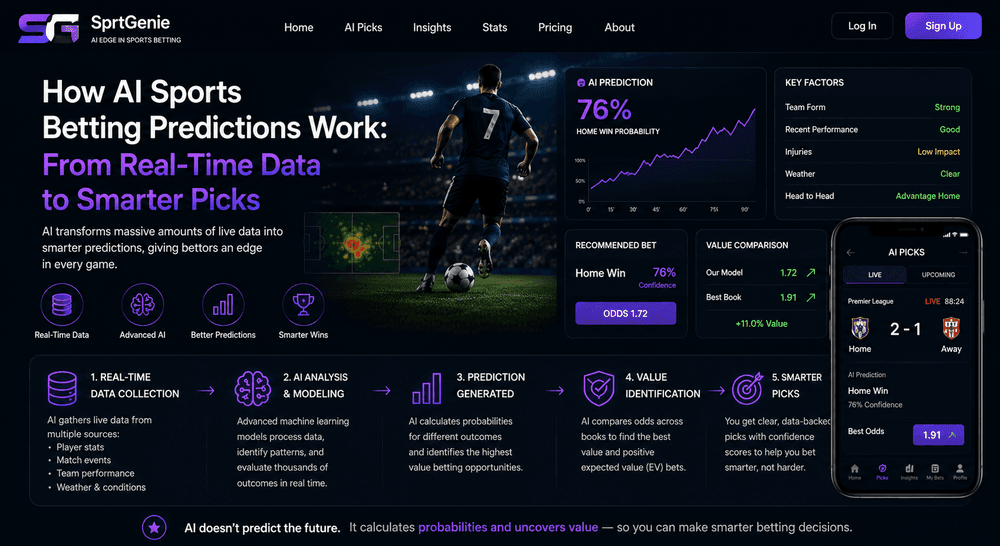
Today, artificial intelligence can process many of the same inputs much faster, generating predictions across multiple sports and markets in real time.
This development creates an important question: are AI sports picks more data-driven than expert picks?
The simple answer is that AI generally processes more structured data, while experienced human analysts can interpret context that may be difficult to represent numerically. Neither approach is automatically more accurate, and neither can guarantee winning results.
A more useful comparison focuses on how each approach collects information, evaluates probabilities, responds to new developments, explains uncertainty, and measures performance. Understanding these differences can help bettors choose better research tools and avoid following picks without examining the reasoning behind them.
What Are AI Sports Picks?
AI sports picks are selections generated with the help of statistical algorithms, machine-learning models, or automated analytical systems.
The system may analyze:
- Historical team performance
- Player statistics
- Recent form
- Injuries and starting lineups
- Home and away records
- Rest and travel schedules
- Weather
- Opponent matchups
- Sportsbook odds
- Line movement
- Live game information
After processing these inputs, the model estimates the probability of an outcome. The result may be presented as a moneyline pick, point spread prediction, total, player prop, parlay selection, or live betting insight.
A complete AI-generated pick may include:
- Recommended market
- Estimated win probability
- Current sportsbook odds
- Implied market probability
- Model edge
- Confidence score
- Risk rating
- Supporting statistics
The most important characteristic of an AI pick is not that a computer selected it. Its value depends on the quality of the data, the model design, the freshness of the information, and the relationship between the estimated probability and the available price.
What Are Expert Sports Picks?
Expert sports picks are recommendations produced primarily through human analysis.
A professional handicapper may review statistical data, game film, player interviews, injury reports, coaching decisions, tactical matchups, and sportsbook line movement. The expert then combines this information with experience and judgment to form a prediction.
Some analysts rely heavily on quantitative models. Others focus more on qualitative factors, such as team motivation, coaching strategy, locker-room conditions, or how a particular player matches up against an opponent.
Human expertise can be valuable when the available data does not tell the complete story. However, expert picks may also be affected by personal bias, inconsistent methods, limited research time, or selective interpretation of statistics.
The term “expert” is also used broadly. It may describe an experienced professional with a transparent performance record, or it may simply be a marketing label attached to someone publishing opinions online. Bettors should evaluate the process and results rather than relying on the title alone.
The Main Difference: Processing Data vs. Interpreting Context
AI and human experts can use many of the same sources, but they process them differently.
AI is particularly effective at evaluating large quantities of structured information. It can compare thousands of games, calculate probabilities, identify patterns, and update predictions when new data arrives.
Human analysts are generally better at evaluating unstructured or ambiguous information. They can interpret interviews, coaching comments, tactical changes, game film, and unusual circumstances that may not yet appear in a statistical database.
The distinction can be summarized as follows:
| Area | AI sports picks | Expert picks |
|---|---|---|
| Data volume | Can process very large datasets | Limited by available research time |
| Speed | Generates and updates predictions rapidly | Requires manual review |
| Consistency | Applies the same model rules repeatedly | Analysis may vary between games |
| Emotional bias | Less affected by personal preferences | Can be influenced by narratives or loyalty |
| Contextual judgment | Depends on how context is represented in data | Can interpret qualitative information |
| Explainability | Varies by platform and model design | Experts can explain reasoning directly |
| Multi-sport coverage | Can scale across many sports and markets | Expertise is usually concentrated |
| Adaptability | Updates when new data enters the system | Can react quickly to breaking news |
| Creativity | Limited to modeled relationships and rules | Can identify unusual strategic factors |
| Accountability | Requires transparent model records | Requires a verified expert track record |
Neither side wins every category. The most effective approach often combines large-scale AI analysis with focused human review.
How AI Uses Sports Data
AI sports prediction systems generally follow a structured analytical process.
Data Collection
The platform collects historical and real-time information from sports databases, schedules, injury feeds, lineup reports, weather services, and sportsbook markets.
Depending on the sport, the data may include:
- Scoring efficiency
- Possession and pace
- Passing, rushing, or shooting performance
- Player usage
- Defensive matchups
- Pitching statistics
- Goaltender performance
- Rest and travel
- Venue conditions
- Opening and current odds
A multi-sport platform can collect information for thousands of events and betting markets simultaneously.
Data Cleaning
Raw sports data may contain duplicates, inconsistent player names, missing statistics, postponed events, or outdated information. The system must clean and standardize the inputs before using them.
This stage is less visible to users but critically important. A sophisticated model cannot produce reliable results if it receives incorrect or mismatched data.
Feature Engineering
The model transforms basic statistics into variables that may be more useful for prediction.
For example, an NBA model may calculate:
- Offensive efficiency over the last ten games
- Expected pace
- Performance with and without an injured starter
- Opponent defense against specific positions
- Projected player minutes
- Rest disadvantage
An NFL model may evaluate quarterback performance under pressure, offensive line protection, defensive coverage, expected game script, and weather-adjusted passing efficiency.
These engineered features help the system examine relationships that are not obvious from a basic box score.
Probability Estimation
The AI model uses the selected variables to estimate the likelihood of different outcomes.
Instead of saying only that Team A will win, the model may estimate:
- Team A: 57% probability
- Team B: 43% probability
You can then compare the probability with sportsbook odds.
If the sportsbook price implies that Team A has a 50% chance of winning, the model may identify a potential edge. If the sportsbook price already implies a 62% probability, the same team may not represent value.
This is an important advantage of probability-based analysis: the most likely winner is not always the best bet.
Real-Time Updating
AI systems can recalculate predictions when new information becomes available.
Potential updates include:
- A player being ruled out
- A starting lineup being confirmed.
- A goaltender change
- A weather forecast shifting
- A sportsbook line moving.
- A live game entering a new situation
The ability to update many predictions quickly gives AI a practical advantage in fast-moving markets.
How Human Experts Use Data
Professional human handicappers also use statistics, but their process may be less standardized.
An expert may begin with quantitative research and then add observations based on experience. This can include film study, knowledge of coaching tendencies, awareness of team dynamics, or an understanding of how certain players respond to specific tactical situations.
Film and Tactical Analysis
Statistics describe what happened, but game film can help explain why.
A football expert may notice that an offensive line is struggling against a particular pressure scheme. A basketball analyst may identify a defensive coverage that creates favorable shots for a specific player. A baseball expert may notice a mechanical change in a pitcher before it significantly affects season-long statistics.
AI can incorporate some tactical factors when they are available as structured data, but human observation may recognize them earlier.
Interpreting News and Interviews
Not all news has equal importance. A coach may describe a player as “available,” but an experienced analyst may recognize that the player is likely to have limited minutes or a reduced role.
Human experts can interpret tone, history, and context. An automated system may treat an availability label too literally unless it also receives reliable playing-time projections.
Specialized Knowledge
A strong expert often focuses on a limited number of sports, leagues, or betting markets. This specialization can produce deep knowledge of teams, coaches, players, and market behavior.
The tradeoff is scale. An analyst specializing in NFL player props may not have the same expertise in MLB totals, NHL goaltender markets, tennis matches, and college basketball spreads.
Where AI Uses Data More Effectively
AI has several clear advantages when the problem involves large quantities of structured information.
Processing Large Datasets
No one can manually examine every historical game, player split, matchup, and sportsbook price across dozens of leagues. AI can process these inputs at scale.
This is especially useful when identifying potential opportunities across a large daily schedule.
Applying Consistent Rules
AI evaluates each game according to the same model logic. It does not become more optimistic about a team because it won the previous night or because the team is popular.
Consistency helps reduce recency bias, confirmation bias, and emotional decision-making.
Comparing Multiple Markets
An automated system can evaluate moneylines, spreads, totals, and player props across many events. It can rank the results by probability, model edge, confidence, or risk.
A human expert may analyze fewer markets in greater depth, but cannot cover the same volume at the same speed.
Monitoring Real-Time Odds
Sportsbook prices change constantly. AI can monitor several sportsbooks and identify when a line changes or a better price becomes available.
This capability is valuable because a prediction cannot be separated from its price. A selection that offers value at +140 may be unattractive after moving to +105.
Finding Statistical Relationships
Machine-learning models can detect relationships between variables that may be difficult to identify manually.
These relationships can involve combinations of pace, efficiency, player usage, opponent strength, rest, weather, and market behavior.
However, statistical correlation is not automatically meaningful. Models must be tested carefully to avoid learning temporary or accidental patterns.
Where Expert Picks Can Use Information More Effectively
Human analysts may have an advantage when context is incomplete, unusual, or difficult to quantify.
Evaluating Unstructured Information
Interviews, tactical adjustments, coaching decisions, and game film do not always fit neatly into a database.
An expert can combine these sources and determine whether they are relevant to a particular market.
Recognizing Structural Changes
Historical averages may become less useful after a major trade, coaching change, quarterback replacement, or lineup adjustment.
A human analyst may recognize that a team has fundamentally changed before the new performance level is fully reflected in the data.
Questioning the Model
AI produces results based on its inputs and design. It does not necessarily know when a dataset is misleading unless it has been programmed to identify the issue.
A human can ask:
- Is this historical sample still relevant?
- Has the player’s role changed?
- Does the matchup create an unusual tactical problem?
- Is the market reacting to information the model has not received?
- Is the projection relying too heavily on recent performance?
This critical review can prevent users from treating model output as unquestionable fact.
Communicating Complex Reasoning
A skilled expert can explain a prediction in natural language, answer follow-up questions, and acknowledge uncertainties that a numerical confidence score may not represent.
AI platforms can also provide explanations, but the quality varies. Some generate generic commentary that sounds convincing but doesn't accurately describe the underlying model.
AI Picks vs. Expert Picks Across Major US Sports
The relative strengths of AI and human analysis can differ by sport.
NFL
AI can process quarterback metrics, offensive efficiency, defensive pressure, player injuries, weather, rest, and sportsbook line movement.
Human analysts may contribute through film study, coaching tendencies, offensive line evaluation, and tactical matchup analysis.
NFL schedules contain relatively few games compared with other major leagues. This creates smaller samples and gives unusual events greater influence. Combining statistical models with contextual review can therefore be particularly useful.
NBA
NBA markets generate large quantities of team and player data. AI is well suited to evaluating pace, usage, player minutes, lineup combinations, shooting efficiency, and defensive matchups.
The main challenge is rapid lineup news. Human experts who closely follow team reports may interpret player availability and expected minutes before an automated system fully adjusts.
For player props, the strongest approach often combines current projections with a final review of confirmed lineups.
MLB
Baseball provides extensive historical and event-level data, making it well suited to statistical modeling.
AI can evaluate starting pitchers, bullpens, batter-pitcher matchups, ballpark factors, weather, defensive quality, and lineups. Human analysts may identify mechanical changes, strategic bullpen decisions, or lineup developments that are not yet reflected in historical numbers.
Because MLB offers games almost every day, AI has a significant advantage in processing volume.
NHL
AI can analyze expected goals, shot volume, goaltender performance, special teams, rest, travel, and line combinations.
Human analysis becomes especially valuable when interpreting starting goaltender uncertainty, coaching changes, and tactical adjustments. A late goaltender confirmation can materially affect both moneyline and total projections.
College Sports
College football and basketball present additional modeling challenges because of the number of teams, uneven competition, player turnover, and differences in data quality.
AI can process the large schedule, but expert knowledge of individual programs, coaching systems, and roster changes may provide important context.
Player Props: AI or Expert Analysis?
Player prop markets depend on individual workload and performance. AI can evaluate thousands of player-level variables, including:
- Projected minutes or snaps
- Usage rate
- Target share
- Recent workload
- Opponent performance by position
- Home and away splits
- Injuries
- Available prop lines
This gives AI an advantage in scale and statistical comparison.
Human experts may be better at recognizing role changes that have not yet produced a large statistical sample. Examples include a receiver becoming the primary target after an injury or an NBA reserve entering the starting lineup.
The most effective player prop analysis should include both a model projection and a current explanation of the player’s expected role.
Parlays: Can AI Make Better Combinations?
Parlays introduce a different problem because the probability of every leg must be considered together.
AI can:
- Estimate the probability of each leg.
- Calculate approximate combined probability.
- Compare the probability with the offered payout.
- Identify potential correlations
- Rank combinations by risk
- Detect one weak leg that reduces the overall quality.
Human experts may contribute by evaluating whether the logical relationship between selections makes sense.
Neither AI nor an expert can remove the increased risk associated with adding more legs. A larger potential payout normally reflects a lower probability of winning.
Live Betting: Speed vs. Interpretation
Live betting highlights the different strengths of AI and human analysis.
AI can update probabilities rapidly based on the score, time remaining, possession, player performance, substitutions, and live odds. It can monitor multiple games at once and react faster than a person working manually.
A human watching the event may notice tactical changes, player fatigue, injuries, or momentum-related developments that have not yet entered the data feed.
Speed favors AI, while visual and tactical interpretation may favor the human observer. Both are limited because live markets adjust rapidly and can become highly volatile.
Common Weaknesses of AI Sports Picks
AI should not be assumed to be objective or accurate simply because it uses mathematics.
Poor or Delayed Data
Incorrect injuries, outdated odds, or missing lineup information can distort the prediction.
Overfitting
A model may perform well on historical data because it learned random or temporary relationships that don't continue into future games.
Limited Explainability
Some systems provide a pick without clearly explaining which variables influenced it.
False Precision
A probability such as 63.7% may appear exact, but it remains an estimate. Excessive precision can create more confidence than the data supports.
Failure to Recognize Context
A model may not understand that a team’s historical record is less relevant after a major tactical or personnel change.
Market Timing
A correct prediction can still become a poor bet when the odds move. AI picks must always be evaluated against the current price.
Common Weaknesses of Expert Picks
Human analysis also carries significant limitations.
Emotional Bias
Personal preferences, recent results, popular narratives, or previous predictions can influence experts.
Inconsistent Methodology
A handicapper may apply one analytical standard to one game and a different standard to another.
Limited Coverage
A person has limited time and cannot deeply analyze every sport and market.
Selective Reporting
Some pick sellers highlight recent wins while ignoring losses or deleting unsuccessful predictions.
Overconfidence
Experience can create confidence without sufficient statistical support. A persuasive explanation is not necessarily evidence that the pick offers value.
Narrative-Based Reasoning
A story about motivation, revenge, or momentum may sound convincing while having little measurable predictive value.
How to Evaluate AI and Expert Track Records
Regardless of who produces the pick, evaluate performance using the same standards.
Sample Size
A short winning streak does not prove predictive skill. Review results across many selections.
Average Odds
A win rate has little meaning without knowing the average price. Winning 70% of bets at -300 is very different from winning 55% at +110.
Return on Investment
ROI compares profit or loss with the total amount risked. It provides more context than win rate alone.
Closing Line Value
Closing line value measures whether a bettor consistently obtains a better price than the market’s closing price.
For example, placing a selection at +140 that closes at +110 may indicate that the original price was favorable, even if that individual bet loses.
Complete Reporting
A transparent record should include both wins and losses. Results should not be limited to selected sports, time periods, or successful examples unless those limitations are clearly disclosed.
Performance by Market
A model or expert may perform well in NFL spreads but poorly in NBA player props. Separate results by sport and betting market.
A Better Approach: Combine AI With Human Judgment
The comparison does not have to end with choosing one side. AI and human analysis can be used at different stages of the same process.
Step 1: Use AI to Scan the Betting Board
AI can evaluate many games and markets, rank potential opportunities, and identify selections where model probability differs from sportsbook probability.
This reduces the amount of manual research required.
Step 2: Review the Supporting Data
Examine the statistics, probability, current odds, confidence level, and risk rating.
Do not treat the recommendation as complete without understanding why it was produced.
Step 3: Check Current Context
Review injuries, lineups, weather, coaching news, and recent market movement.
Determine whether the model is using the latest available information.
Step 4: Compare Sportsbook Prices
A model edge can disappear when odds change. Compare multiple sportsbooks and confirm that the current price still supports the prediction.
Step 5: Apply Critical Judgment
Ask whether the historical sample remains relevant and whether any unusual circumstance could weaken the model’s assumptions.
Step 6: Bet or Pass
A bettor does not need to act on every prediction. Passing is appropriate when the price is unfavorable, important information is missing, or the uncertainty is too high.
Step 7: Track the Result
Record the selection, odds, model probability, closing line, and result. Evaluate performance across a meaningful sample.
How SprtGenie Supports Data-Driven Betting Research
SprtGenie is designed to help users access AI-generated sports predictions, real-time odds, confidence information, risk assessments, and personalized insights through mobile and web applications.
Rather than relying only on a final pick, users can review the available data and evaluate how the model’s estimated probability compares with current market conditions.
SprtGenie can help streamline several stages of the research process:
- Processing sports and betting-market data
- Generating probability-based insights
- Monitoring current odds
- Presenting suggested picks
- Communicating confidence and risk
- Personalizing information by sport and market
- Providing live-game context
Its SnapTap feature allows users to capture a photo or short video of a match. The system can recognize the event and provide relevant AI insights, suggested picks, odds, confidence information, and risk.
These tools are intended to support human decision-making. They do not guarantee a winning outcome, and the user remains responsible for deciding whether a selection is appropriate.
Which Approach Uses Data More Effectively?
AI uses structured data more efficiently in terms of volume, speed, consistency, and real-time calculation. It can process more games, players, and betting markets than an individual expert.
Human experts may use contextual information more effectively. They can interpret tactical changes, interviews, game film, and unusual situations not fully represented in the data.
Therefore, the answer depends on what “effectively” means:
- For large-scale statistical processing, AI has the advantage.
- For qualitative interpretation, experienced human analysts may have the advantage.
- For fast odds monitoring, AI is more efficient.
- For challenging assumptions and recognizing unusual context, human judgment remains valuable.
- For a complete betting workflow, combining both approaches may be more practical than relying exclusively on either one.
Final Thoughts
AI sports picks and expert picks are not fundamentally opposed. They are two methods of organizing uncertainty.
AI provides scale, speed, consistency, and probability-based analysis. Human experts contribute interpretation, specialized experience, tactical understanding, and critical judgment.
Neither approach can guarantee results. AI models can fail because of poor data, overfitting, outdated information, or changing market prices. Experts can fail because of bias, inconsistent methods, selective reporting, or overconfidence.
The strongest process uses AI to identify potential opportunities and human judgment to evaluate whether the assumptions remain valid. Bettors should check current odds, review supporting information, understand the risk, and track performance over time.
A pick is not valuable simply because it came from an advanced model or a recognized expert. Its usefulness depends on transparent reasoning, reliable data, current market prices, and realistic probability estimates.
SprtGenie can support this process by making AI-powered sports analysis more accessible. However, every prediction remains uncertain, and all betting decisions should be made responsibly and in accordance with applicable age and jurisdiction requirements.
FAQ:
Are AI sports picks better than expert picks?
AI picks are generally better at processing large datasets quickly and consistently. Expert picks may be better at interpreting tactical changes, interviews, game film, and unusual context. Neither approach is automatically more accurate.
How does AI generate sports picks?
AI collects sports statistics, player data, injuries, schedules, weather, and sportsbook odds. Predictive models analyze these inputs and estimate the probability of different outcomes.
Can AI sports picks guarantee a win?
No. AI can estimate probabilities, but it cannot eliminate injuries, random variation, coaching decisions, or other unpredictable events.
Are expert sports picks reliable?
Some experts use rigorous and transparent methods, while others rely heavily on opinion or marketing. Evaluate reliability through a complete track record, average odds, ROI, sample size, and closing line value.
Does AI eliminate emotional bias from sports betting?
AI is not influenced by team loyalty or emotion in the same way a person may be. However, models can still contain bias caused by their training data, assumptions, or design.
What is the difference between an AI pick and a statistical model?
A statistical model may use predefined mathematical relationships, while an AI or machine-learning model can learn more complex patterns from data. In practice, many prediction platforms combine several statistical and machine-learning methods.
Why do AI predictions change before a game?
Predictions can change when injuries, starting lineups, weather, or sportsbook odds are updated. A current prediction is generally more useful than one based on outdated conditions.
Are AI player prop predictions useful?
AI can process player minutes, workload, usage, matchups, injuries, and current prop lines. These projections can support research, but late lineup changes and unexpected game situations remain important risks.
Can experts identify information that AI misses?
Yes. Human experts may recognize tactical changes, coaching decisions, player limitations, and team developments not yet reflected in structured data.
What metrics should be used to compare AI and expert picks?
Useful metrics include sample size, average odds, ROI, performance by sport and market, probability calibration, and closing line value. Win rate alone is insufficient.
Should bettors use AI picks and expert picks together?
A combined approach can be effective. AI can scan large datasets and identify potential opportunities, while human review can evaluate context, current news, and the assumptions behind the prediction.
How can users avoid unreliable prediction services?
Avoid services that promise guaranteed wins, publish unverifiable accuracy percentages, hide losing picks, use outdated odds, or provide recommendations without probabilities and explanations.