
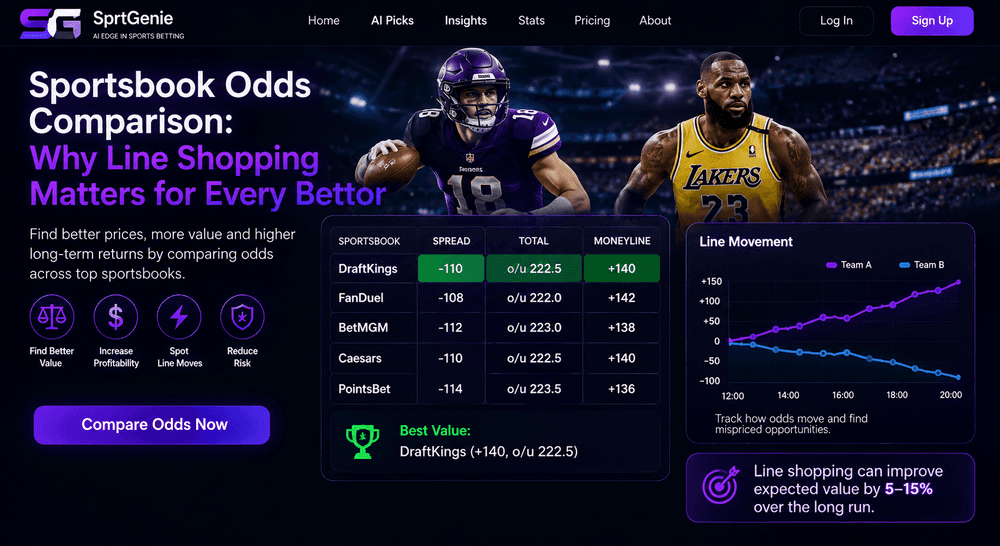
One may list an NFL underdog at +125 while another offers +140. An NBA point spread may be -110 at one sportsbook and -105 at another. Player prop lines can differ in both price and the statistical threshold a player must exceed.
These differences may appear small, especially when evaluating a single bet. Over a larger sample, however, consistently accepting weaker odds can reduce returns, increase the break-even win rate, and turn a potentially valuable betting strategy into an unprofitable one.
Comparing sportsbook odds before placing a wager is known as line shopping. It is one of the most practical ways to improve the price of a betting decision without changing the underlying prediction.
Line shopping does not guarantee that a selection will win. It simply ensures that if a bettor decides to act on a prediction, the decision is made at the strongest reasonably available price.
What Is Sportsbook Odds Comparison?
Sportsbook odds comparison is the process of reviewing the prices offered by multiple sportsbooks for the same event and market.
The comparison may involve:
- Moneyline odds
- Point spreads
- Game totals
- Team totals
- Player props
- Futures
- Parlays
- Live betting markets
The goal is to determine which sportsbook offers the most favorable combination of line and price.
For positive American odds, the larger number generally provides the better potential return. A price of +140 is more favorable than +120 for the same selection.
For negative American odds, a number closer to zero generally requires less risk. A price of -105 is more favorable than -120 when the market and line are identical.
However, comparing sportsbook odds requires more than selecting the largest number on the screen. Bettors must verify that the markets have the same threshold, rules, and settlement conditions.
What Is Line Shopping?
Line shopping means searching across multiple sportsbooks for the strongest available betting line or price.
The concept is similar to comparing prices before purchasing a product. If several stores sell the same item, paying more than necessary provides no additional benefit. In sports betting, the “price” is expressed through the odds and market line.
Suppose a bettor wants to back the same NFL team at three sportsbooks:
| Sportsbook | Moneyline |
|---|---|
| Sportsbook A | +115 |
| Sportsbook B | +125 |
| Sportsbook C | +140 |
A $100 bet would produce:
- $115 profit at +115
- $125 profit at +125
- $140 profit at +140
The bettor accepts the same sporting risk in each case. Sportsbook C offers a greater potential return.
Line shopping also applies to negative odds:
| Sportsbook | Price |
|---|---|
| Sportsbook A | -105 |
| Sportsbook B | -110 |
| Sportsbook C | -120 |
If the line is identical, -105 is the most favorable price because it has the lowest break-even requirement and requires less risk relative to the potential profit.
Why Sportsbooks Offer Different Odds
Sportsbooks do not always agree on the exact probability of an outcome. Their prices may differ for several reasons.
Different Trading Models
Each sportsbook can use its own statistical models, data providers, risk controls, and trading systems. One operator may evaluate a team or player differently from another.
Customer Betting Activity
Sportsbooks may adjust odds according to the action they receive. If one platform attracts substantial betting interest on Team A, it may move the price more aggressively than a competitor.
Risk Management
A sportsbook may already have significant financial exposure to one side of a market. Adjusting the line can help the operator attract betting activity on the opposite side.
Market Update Speed
Some sportsbooks respond to injury news, lineup announcements, or competitor movement faster than others. Temporary price differences may appear while the market adjusts.
Different Customer Profiles
A sportsbook serving more recreational users may receive different betting patterns than one used by experienced or high-volume bettors. These differences can influence market prices.
Promotional Strategy
A sportsbook may deliberately offer a stronger price on a popular market to attract attention or new customers. Limits or eligibility conditions may apply.
Market Liquidity
Major NFL and NBA markets generally attract more betting activity than niche competitions or smaller player props. Low-liquidity markets can display wider price differences and may also carry greater uncertainty.
Why Small Odds Differences Matter
A few cents of difference may not seem important when considering one bet. Repeated over hundreds of wagers, the effect becomes much more significant.
Consider the break-even probability for several common prices:
| American odds | Approximate break-even probability |
|---|---|
| -105 | 51.22% |
| -110 | 52.38% |
| -115 | 53.49% |
| -120 | 54.55% |
| +100 | 50.00% |
| +110 | 47.62% |
| +125 | 44.44% |
| +140 | 41.67% |
Moving from -115 to -105 reduces the break-even requirement by more than two percentage points. That difference can determine whether a strategy produces a positive or negative result over time.
Long-Term Example
Suppose a bettor places 100 wagers, risks $100 on each one, and wins 53.
At -110, a $100 risk produces approximately $90.91 in profit.
- Profit from 53 wins: approximately $4,818.23
- Loss from 47 losses: $4,700
- Net result: approximately +$118.23
At -115, a $100 risk produces approximately $86.96 in profit.
- Profit from 53 wins: approximately $4,608.88
- Loss from 47 losses: $4,700
- Net result: approximately -$91.12
The selections and win rate are identical. The bettor moves from a small profit to a loss because of the weaker price.
This example demonstrates why odds comparison is not merely an optional improvement. Price is a fundamental part of the betting decision.
Understanding American Odds and Implied Probability
American odds can be converted into implied probability. This allows bettors to compare the sportsbook price with a statistical model or personal probability estimate.
Positive Odds
For positive American odds:
Implied probability = 100 ÷ (positive odds + 100)
At +140:
100 ÷ (140 + 100) = 41.67%
The price represents a break-even implied probability of approximately 41.67%.
At +120:
100 ÷ (120 + 100) = 45.45%
The same selection requires a higher win rate to break even at +120 than at +140.
Negative Odds
For negative American odds:
Implied probability = absolute odds ÷ (absolute odds + 100)
At -105:
105 ÷ (105 + 100) = 51.22%
At -120:
120 ÷ (120 + 100) = 54.55%
A bettor accepting -120 instead of -105 needs the selection to win more frequently to reach the theoretical break-even point.
These implied probabilities generally contain part of the sportsbook’s margin. Nevertheless, they provide a useful starting point for understanding how price affects the decision.
Price Shopping vs. Line Shopping
The terms are often used together, but they can describe two related activities.
Price Shopping
Price shopping means comparing odds on the same line.
Example:
- Over 45.5 at -105
- Over 45.5 at -115
The threshold is identical, so -105 is clearly the stronger price.
Line Shopping
Line shopping may involve comparing different thresholds.
Example:
- NFL underdog +3 at -105
- NFL underdog +3.5 at -115
The first sportsbook offers a better price, but the second offers an extra half-point. The stronger option depends on how valuable that half-point is.
This distinction matters most around key numbers.
Why Key Numbers Matter
Certain margins occur more frequently in some sports.
In NFL betting, point spreads around 3 and 7 are particularly important because games often finish with those scoring margins. Receiving +3.5 instead of +3 can be more valuable than receiving an ordinary half-point elsewhere.
In basketball, individual half-points are generally less concentrated around a few specific margins, although they can still determine whether a bet wins, loses, or pushes.
When comparing spreads or totals, bettors should evaluate both:
- The market threshold
- The attached price
A better price on a weaker line is not automatically the better option.
Line Shopping for Moneylines
Moneylines offer the clearest example of sportsbook odds comparison because the selected outcome does not change.
If the same MLB team is available at +135, +145, and +155, the +155 price provides the largest potential return.
For favorites, -125 is more favorable than -140 for the same team.
Moneyline bettors should compare:
- Current price
- Opening price
- Recent line movement
- Sportsbook limits
- Market rules
- Whether listed pitchers or other conditions apply
In baseball, for example, sportsbook settlement rules may differ when a scheduled starting pitcher changes. Bettors should verify whether the market is action regardless of the pitcher or depends on the listed starters.
Line Shopping for Point Spreads
Spread comparisons require attention to both the number and price.
Consider an NBA favorite:
- -4 at -115
- -4.5 at -105
The second option has a lower price but requires the team to cover a larger spread. The bettor must determine whether saving ten cents is worth accepting the extra half-point.
Another sportsbook may offer:
- -3.5 at -125
This option costs more but offers a more favorable line. The best choice depends on the estimated probability of each result and the value of the half-point.
A proper comparison should not treat these markets as identical.
Line Shopping for Totals
Totals markets can differ in both threshold and price.
For example:
- Over 47.5 at -110
- Over 48 at -105
- Over 48.5 at +100
The highest listed price does not necessarily represent the best value because the required score also changes.
Bettors should estimate the probability of the game finishing at or near each number. In lower-scoring sports, a half-point can be particularly meaningful.
Weather, injuries, pace, starting lineups, and market movement can all affect totals prices.
Line Shopping for Player Props
Player prop markets frequently show significant differences across sportsbooks.
One sportsbook may offer:
- Player over 74.5 receiving yards at -110
Another may offer:
- Player over 71.5 receiving yards at -115
A third may offer:
- Player over 74.5 receiving yards at +105
The user must compare the probability and price for each variation.
A lower threshold may be worth accepting at a slightly higher price, especially when the difference crosses an important part of the player’s performance distribution.
AI player projection tools can help by estimating:
- Expected playing time or snap count
- Usage and workload
- Target share
- Matchup quality
- Recent performance
- Injury-related role changes
- Probability of exceeding different thresholds
Player prop markets can move rapidly after lineup or injury announcements. Real-time odds comparison is therefore particularly valuable.
Line Shopping for Parlays
Parlay pricing can be less transparent because several selections are combined into one payout.
Two sportsbooks may offer different payouts for the same parlay, even when every leg appears identical. Differences can result from:
- Individual leg prices
- Sportsbook margin
- Correlation adjustments
- Same-game parlay rules
- Maximum payouts
- Promotional boosts
Bettors should compare the final parlay payout rather than assuming every sportsbook calculates the combination identically.
They should also confirm that the rules for pushes, canceled legs, overtime, and player participation are the same.
A higher parlay payout does not make the bet safe. Adding more legs reduces the probability that the entire combination will win.
Line Shopping for Futures
Futures markets can display substantial differences because they have lower liquidity and longer settlement periods.
Examples include:
- Super Bowl winner
- NBA championship winner
- Season win totals
- MVP awards
- Player statistical leaders
- Playoff qualification
A team may be +900 at one sportsbook and +1200 at another. On a $100 bet, this represents a $300 difference in potential profit.
However, futures bettors should also review:
- Maximum stake
- Maximum payout
- Cash-out rules
- Dead-heat rules
- Whether the stake will remain unavailable for months
- How injuries or schedule changes are handled
Real-Time Odds and Line Movement
Sportsbook odds change as new information enters the market.
Important causes of movement include:
- Injuries
- Starting lineup confirmations
- Weather
- Player workload updates
- Betting activity
- Market-maker adjustments
- Competing sportsbook prices
- Live game developments
A line-shopping tool should display recent and current prices with clear timestamps. Odds that were available an hour ago may no longer be actionable.
Opening Line
The opening line is one of the first prices published for an event. Early markets may have lower limits and greater uncertainty.
Current Line
The current line reflects subsequent information and betting activity. It may differ substantially from the opening price.
Closing Line
The closing line is the final market price shortly before the event begins. It often reflects the most information and market activity.
What Is Closing Line Value?
Closing line value, or CLV, compares the price obtained by a bettor with the market’s final price.
Suppose a bettor takes an NFL team at +140. The market later closes at +110.
The original +140 price offers a greater return than the closing price. This is generally considered positive closing line value.
The individual bet may still lose. CLV does not determine the game result. It indicates whether the bettor obtained a price that was more favorable than the final market.
Consistently beating the closing line can suggest that the bettor or analytical model is identifying useful prices before the market fully adjusts.
However, closing lines are not perfect. Sportsbooks may close at different prices, and low-liquidity markets can remain inefficient.
Sportsbook Odds Comparison and Positive Expected Value
Line shopping becomes particularly important when evaluating positive expected value.
Expected value depends on:
- Estimated probability
- Available odds
- Potential profit
- Amount risked
Suppose an AI model estimates that an underdog has a 45% probability of winning.
At +150
A $100 bet has the following theoretical EV:
EV = (0.45 × $150) − (0.55 × $100)
EV = $67.50 − $55
EV = +$12.50
At +120
EV = (0.45 × $120) − (0.55 × $100)
EV = $54 − $55
EV = -$1
The same prediction appears to have a positive EV at +150 and a negative EV at +120.
This is why a betting pick cannot be evaluated independently from its current price.
How AI Can Improve Sportsbook Odds Comparison
Artificial intelligence can make odds comparison more efficient by processing large numbers of markets simultaneously.
An AI-powered platform may:
- Monitor odds across several sportsbooks.
- Identify the best available price.
- Detect significant line movement.
- Convert odds into implied probability.
- Compare market probability with model probability.
- Rank potential opportunities
- Display confidence and risk information
- Update projections after injuries or lineup changes
AI is especially useful when the daily schedule contains many events and player props. A person may not be able to review every market manually before prices change.
However, automated comparison must use accurate and current data. A delayed odds feed can display prices that are no longer available.
Step-by-Step Line-Shopping Process
A consistent workflow can help bettors compare sportsbook odds accurately.
Step 1: Define the Exact Market
Record:
- Event
- Selection
- Market type
- Spread, total, or prop threshold
- Overtime or settlement rules
Step 2: Check Multiple Sportsbooks
Compare at least several available operators. More sources may reveal a wider range of prices.
Step 3: Confirm That the Markets Are Identical
Do not compare an over 24.5 with an over 25.5 as if they were the same selection. Check prices, thresholds, and rules.
Step 4: Convert Odds Into Implied Probability
This helps quantify the difference between sportsbook prices.
Step 5: Compare the Price With the Prediction
If using an AI model, review the estimated probability and determine whether the current price still provides sufficient value.
Step 6: Check the Timestamp
Confirm that the displayed odds remain available.
Step 7: Review Recent Line Movement
Determine whether injuries, lineups, weather, or other developments caused the price to change.
Step 8: Decide Whether to Bet or Pass
If the favorable price has disappeared, passing may be more appropriate than accepting a materially weaker line.
Step 9: Record the Closing Price
Tracking the closing line can help evaluate whether the original price was consistently favorable.
Common Line-Shopping Mistakes
Comparing Different Markets
Two selections may appear similar while using different thresholds, overtime rules, or settlement conditions.
Ignoring the Line to Focus Only on Price
A bettor may choose +100 over -110 without recognizing that the +100 option requires covering an additional point.
Using Delayed Odds
An attractive price is irrelevant if it is no longer available.
Failing to Confirm Player Participation Rules
Sportsbooks may use different rules for player props when an athlete starts, participates briefly, or does not play.
Ignoring Limits
A strong price may have a lower maximum stake or special promotional conditions.
Chasing a Moving Line
A bettor may accept progressively worse prices because of fear of missing the opportunity. If the model edge has disappeared, the more disciplined decision may be to pass.
Opening Too Many Sportsbook Accounts Without Control
Access to multiple sportsbooks can improve price comparison, but it can also make deposit and spending control more difficult. Users should maintain clear limits and track activity across every account.
How Line Shopping Applies Across Major US Sports
NFL
NFL spreads often involve key numbers such as 3 and 7. Bettors should compare both price and point spread carefully.
Weather, quarterback availability, and major injuries can move markets quickly.
NBA
NBA odds can change substantially after lineup announcements. Player prop markets are particularly sensitive to expected minutes and usage changes.
MLB
Starting pitchers, batting lineups, weather, and bullpen availability can affect moneylines, run lines, totals, and props.
Compare sportsbook rules involving listed pitchers as well.
NHL
Confirmed starting goaltenders can create significant movement. Bettors should monitor moneyline, puck line, total, and player prop prices.
College Sports
The large number of teams and uneven market liquidity can produce wider differences between sportsbooks. Data quality and limits may also vary.
What to Look for in an Odds Comparison Tool
A useful sportsbook odds comparison platform should provide:
- Real-time or frequently updated prices
- Multiple sportsbooks
- Clear timestamps
- Moneylines, spreads, totals, and props.
- Opening and current lines
- Line-movement history
- Best-price highlighting
- American, decimal, or fractional odds options
- Search and filtering
- Mobile access
- Alerts for meaningful price changes
More advanced platforms may also provide:
- AI-generated probabilities
- No-vig market estimates
- Expected-value calculations
- Confidence scores
- Risk ratings
- Historical performance
- Closing line tracking
The platform should clearly distinguish between a data-driven estimate and a guaranteed result.
How SprtGenie Supports Odds-Based Research
SprtGenie combines AI-generated sports analysis with real-time odds information, suggested picks, confidence indicators, and risk assessments.
The platform can help users review:
- Current sports betting odds
- AI-generated probabilities
- Potential differences between model and market expectations
- Confidence and risk information
- Relevant game and player statistics
- Changes in live match conditions
SprtGenie’s SnapTap feature lets users capture a photo or short video of a game. The platform can recognize the event and present relevant AI insights, suggested picks, odds, confidence, and risk.
This can reduce the time required to locate a live match and begin reviewing the available information.
Use SprtGenie as a research and insights tool. Users should confirm that the displayed line is still available, compare market terms, and make their own decision.
Sportsbook Odds Comparison Checklist
Before acting on a selection, ask:
- Am I comparing the same event and market?
- Are the spread, total, or prop thresholds identical?
- Are overtime and settlement rules the same?
- Which sportsbook offers the best price?
- Is a better line available at a slightly different price?
- How does each price affect implied probability?
- Are the displayed odds current?
- Has the market moved recently?
- Did an injury, lineup, or weather update cause the movement?
- Does the current price still support the model prediction?
- Are there limits or promotional conditions?
- Have I recorded the line for later comparison with the closing market?
Responsible Use of Multiple Sportsbooks
Line shopping can improve price selection, but using several accounts requires organization and control.
Users should:
- Track deposits and balances
- Establish an overall betting budget.
- Avoid treating separate accounts as separate bankrolls.
- Set deposit and loss limits
- Avoid chasing unavailable prices.
- Never use borrowed money.
- Follow applicable state laws and age requirements.
- Use responsible gambling tools when needed.
Better odds reduce the price paid for a betting decision. They do not remove the possibility of loss.
Final Thoughts
Sportsbook odds comparison matters because every betting decision includes both a prediction and a price.
A bettor can analyze the correct team, player, or market and still make a poor decision by accepting unfavorable odds. Conversely, obtaining a stronger price increases the potential return without changing the underlying sporting risk.
Line shopping can improve:
- Potential payouts
- Break-even probability
- Expected value
- Long-term efficiency
- Closing line value
The effect may be modest on one bet but meaningful across hundreds of decisions.
AI-powered tools can speed up sportsbook odds comparison by monitoring multiple markets, estimating probabilities, identifying line movement, and organizing opportunities. The user must still confirm that markets are identical, check current availability, and determine whether the price supports the prediction.
No betting line guarantees a win. The purpose of line shopping is not to remove uncertainty but to avoid paying more than necessary for the same risk.
FAQ:
What is sportsbook odds comparison?
Sportsbook odds comparison is the process of reviewing prices from multiple sportsbooks for the same event and market to identify the most favorable available line or odds.
What is line shopping in sports betting?
Line shopping means comparing sportsbook prices and market thresholds before placing a wager. The goal is to get a better price or a more favorable line.
Why do sportsbooks offer different odds?
Differences can result from separate trading models, customer activity, risk exposure, update speed, market liquidity, and promotional strategies.
Is -105 better than -110?
Yes, if the event, selection, line, and market rules are identical. A price of -105 requires less risk and has a lower break-even probability than -110.
Is +140 better than +120?
Yes, if both prices apply to the same selection and market. A $100 winning bet returns $140 in profit at +140 compared with $120 at +120.
How do I compare different point spreads?
Evaluate both the numerical spread and attached price. A better price may come with a less favorable point spread, so the markets should not be treated as identical.
Why are key numbers important in NFL betting?
Certain scoring margins, particularly 3 and 7, occur more frequently in NFL games. Moving across one of these numbers can be more valuable than an ordinary half-point.
Does line shopping improve expected value?
It can. Better odds reduce the break-even probability and increase the potential return. A selection may offer positive EV at one sportsbook and negative EV at another.
What is closing line value?
Closing line value compares the price obtained with the market’s final price. Consistently obtaining more favorable odds than the closing line can indicate efficient price selection.
How often do sportsbook odds change?
Prices can change at any time, particularly after injuries, lineup announcements, weather updates, major betting activity, or live game events.
Can AI compare sportsbook odds?
AI-powered platforms can monitor multiple prices, calculate implied probabilities, track movement, and compare market odds with model estimates. The data must be current and accurate.
Does getting the best odds guarantee a winning bet?
No. Better odds improve the price and potential return, but the underlying sporting outcome remains uncertain.