
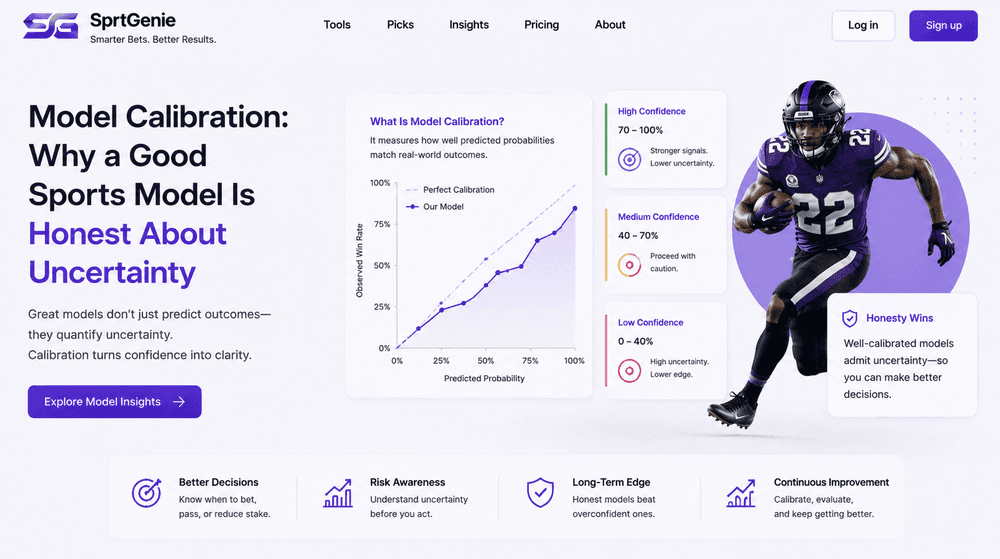
Model Calibration: Why a Good Sports Model Is Honest About Uncertainty
When a prediction app says “89% accurate,” most people picture a crystal ball. But there is a quieter, more useful property that separates a trustworthy model from a marketing number: calibration.
A calibrated model is one whose probabilities mean what they say, when it calls
something 70%, that thing happens about 70% of the time over many predictions.
It is less flashy than a big accuracy stat, and far more important.
What calibration actually means
Imagine gathering every pick a model rated at “70% confidence” over a season.
If the model is well calibrated, roughly 70% of those picks hit. Do the same for
its 55% picks, and about 55% should hit. The percentages are not marketing, they
are promises the model keeps on average.
A model can be “accurate” in a headline sense and still be badly calibrated.
If it labels everything 90% and only 60% of those land, it is overconfident,
and any decision you make trusting that 90% is built on sand.
Why calibration beats a headline “win rate”
A single accuracy number, “hits 78% of the time”, hides everything that matters:
- Over what sample? Ten picks or ten thousand?
- Over what window? One hot month, or multiple seasons?
- On what markets? Heavy favorites are “right” a lot and pay almost nothing.
You can look accurate simply by only betting −500 favorites. Calibration is harder
whether it picked winners. A calibrated 60% is worth more than an uncalibrated 90%,
because you can actually size and compare bets around a number you can trust.
How calibration is measured
Two common tools, in plain terms:
- Reliability diagram. Group predictions by their stated probability
(all the ~60% calls, all the ~70% calls) and plot stated vs actual. A perfectlycalibrated model sits on the diagonal line. Points above or below reveal whereit is under- or over-confident. - Brier score. A single number that rewards being both correct
and appropriately confident, and punishes confident-and-wrong more thanunsure-and-wrong. Lower is better.
You do not need to compute these to benefit from them. You just need to know that
a serious model is judged this way, not by a trophy percentage.
Why calibration matters to you, the bettor
Calibration is what makes a confidence score usable. If “70%” reliably means 70%,
and decide if there is value. If the number is uncalibrated, that comparison is
meaningless, and so is the pick.
It also protects you from the most expensive mistake in betting: acting big on false
certainty. A calibrated model that says “58%, medium risk” is telling you the truth
about a close call. An overconfident one that says “92%” on the same game is quietly
setting you up to over-stake.
What good teams do about it
Building a calibrated model is ongoing work: tune probabilities toward calibration
rather than toward a hit rate, test on data the model has never seen, and re-check
calibration as new games arrive, because a model that was calibrated last season
can drift. The goal is not to sound impressive, it is to be honest at every
confidence level.
That is the philosophy behind how SprtGenie presents picks. Instead of one headline
so the read is honest about uncertainty on that specific game. Any aggregate accuracy
figure we ever share comes with its methodology, sample and window attached, or it
does not get shared.
The bottom line
Accuracy headlines are easy to produce and easy to abuse. Calibration is the real
test: do the model’s probabilities hold up over a large sample, at every confidence
level? A calibrated 60% you can trust will make you better decisions than an
uncalibrated 90% you cannot. When you read a confidence score in SprtGenie, that is
what it is built to be, a number that means what it says.
SprtGenie is a research and analytics tool for adults aged 18 and over. It does not accept bets or handle money, and predictions do not guarantee outcomes. Please bet responsibly and follow the laws of your jurisdiction.