
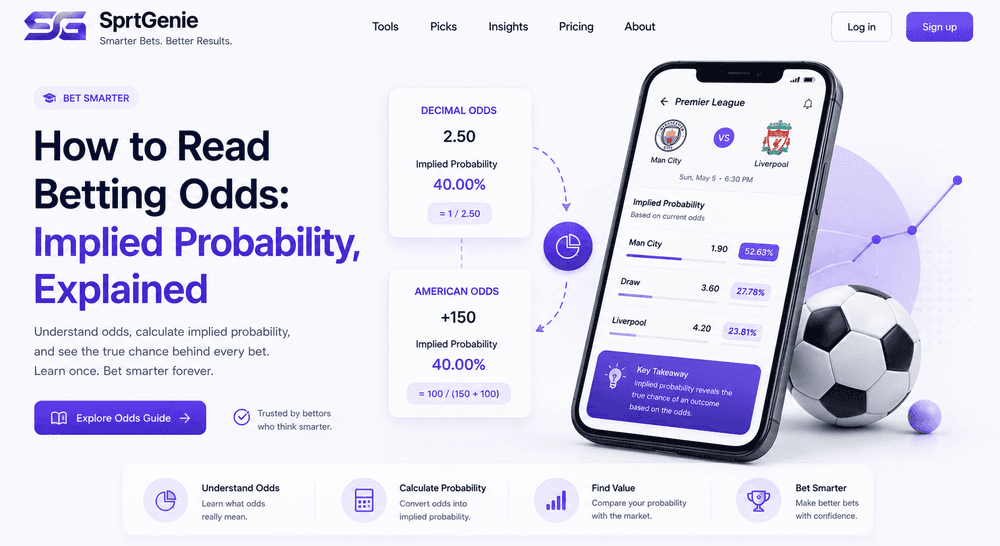
How to Read Betting Odds: Implied Probability, Explained
Odds may look like simple prices, but each one represents an implied probability. Converting odds into percentages helps you understand what the market expects, compare that estimate with your own analysis, and identify when a price may offer better or worse value.
Odds look like a price, but they are really a probability in disguise.
Once you can turn any odds into a percentage, a lot of betting stops feeling like
guesswork: you can see what the market thinks will happen, compare it to your own view,
and spot when a price is generous or stingy. That percentage is called
bettor can learn to calculate.
What implied probability means
Implied probability is the chance of an outcome that a given set of odds is “pricing in.”
If a market implies 60%, the book is treating that outcome as roughly a 6-in-10 shot.
Your job as a bettor is to decide whether the real chance is higher (a potential value bet)
or lower (a pass) than what the odds imply.
Converting odds to a percentage
The math is simple, and it is worth knowing by feel.
American odds
- Negative (favorites): implied % = (−odds) / (−odds + 100).Example: −150 → 150 / 250 = 60%.
- Positive (underdogs): implied % = 100 / (odds + 100).Example: +200 → 100 / 300 = 33.3%.
Decimal odds
Implied % = 1 / decimal.
Fractional odds
Implied % = denominator / (denominator + numerator).
You do not need to do this by hand every time, but understanding it means you can look
at any price and instantly know what it is really saying.
The catch: the vig is baked in
Here is the part that trips people up. Add up the implied probabilities on both sides
game implies about 52.4% on each side, which sums to ~104.8%. That extra ~4.8% is the
That matters for two reasons. First, the raw implied probability slightly
Second, comparing books tells you who is charging the least vig on the bet you want,
which loops straight back to line shopping. To get closer to the “true” market
probability, you can remove the vig (de-vig) by scaling both sides back to 100%, but
even a rough mental adjustment (“subtract a couple of points for juice”) beats reading
the number at face value.
Turning implied probability into decisions
Once odds are a percentage, betting becomes a comparison, not a vibe:
- Find your number. Estimate the real chance of the outcome, from
stats, form, matchups, or a model. - Compare to the implied number. If you think a team wins ~50% of
the time and the odds imply 40%, that gap is where value lives. If your number isbelow the implied one, it is usually a pass. - Respect the vig. A tiny edge can vanish once the juice is accounted
for. Bigger, clearer gaps are the ones worth acting on.
This is exactly what a confidence read is doing under the hood: comparing a model’s
probability estimate against the implied probability in the odds, and flagging where
they meaningfully disagree.
A worked example
Say two books price a tennis match differently. Book A has the underdog at +160
(implied 38.5%), Book B at +180 (implied 35.7%). If your read is that the underdog
actually wins about 45% of the time, both prices imply less than your estimate, so
there may be value, and Book A’s +160 is the better implied number to compare against…
but Book B’s +180 pays more if you take it. Line shopping and implied probability work
How SprtGenie uses this
Inside SprtGenie, you do not have to convert anything by hand. When you snap or open a
game, you get the model’s probability read alongside
implied probability and the AI estimate line up or split, plus a confidence and risk
read to weigh it. The point is not to hand you a “lock,” it is to make the math you
would otherwise skip visible and fast.
The bottom line
Odds are just probabilities wearing a costume. Learn to convert them, remember the vig
is hiding inside, and every price becomes a question you can actually answer: does the
real chance beat the implied one? Get in the habit of reading odds as percentages and
you will make sharper, calmer decisions, whether you do the math yourself or let the
app surface it for you.
SprtGenie is a research and analytics tool for adults aged 18 and over. It does not accept bets or handle money, and predictions do not guarantee outcomes. Please bet responsibly and follow the laws of your jurisdiction.